MARGE’S TRAVEL INSIGHTS
Travel Mistakes That Cost Time and Money—and How to Avoid Them
Avoid common travel mistakes involving flights, passports, insurance, packing, money and disruptions with this practical vacation planning guide.


Experienced travelers do not usually make mistakes because they know too little about travel. Problems often begin when familiarity turns into assumption: the entry rule must be the same as last time, the short connection should be manageable, the insurance policy probably covers everything or the cheapest room will produce the lowest total cost.
Travel changes too quickly for those assumptions to remain reliable. Airlines revise schedules and fare conditions. Countries change entry procedures. Hotels alter inclusions. Airports introduce new screening systems. A trip that worked perfectly two years ago may need a different plan today.
The goal is not to anticipate every possible disruption. It is to identify the decisions most likely to cost time, money or peace of mind—and deal with them while there are still good alternatives.
Mistake 1: Choosing the Deal Before Choosing the Right Trip
A low price can make an unsuitable vacation look compelling. Travelers see a promotion, attractive resort photograph or discounted cruise fare and begin adapting their plans around it before deciding whether the experience actually fits them.
The problem is rarely the promotion itself. The problem is allowing the price to answer questions that have not been asked.
A secluded resort may be ideal for someone seeking quiet but frustrating for a traveler who wants restaurants and nightlife nearby. A large cruise ship may provide excellent family entertainment but overwhelm someone seeking a calm, intimate experience. A centrally located hotel may cost more per night yet reduce transportation expenses and save hours of daily travel.
Start with the travelers rather than the offer. Consider the desired pace, room arrangements, activity level, accessibility, dining expectations and amount of independent exploration. Then compare available promotions among trips that already meet those requirements.
This is especially important for families and groups. The lowest headline price may apply only to a particular room category, occupancy, departure airport or set of dates. Once everyone’s actual requirements are added, the supposed bargain may disappear.
A good deal reduces the cost of the right vacation. It does not turn the wrong vacation into the right one.

Mistake 2: Comparing the Initial Price Instead of the Total Cost
Travel prices are often presented one component at a time. The airfare looks affordable until luggage and seat assignments are added. The resort rate appears competitive until transfers, meals and resort fees are included. A cruise fare may exclude gratuities, drinks, specialty dining, shore excursions and transportation to the port.
Comparing only the first visible number creates a distorted decision.
Before booking, build a realistic total that includes the expenses likely to affect your particular trip:
Transportation to and from the departure airport
Airfare, luggage and advance seat-selection charges
Hotel, cruise or resort taxes and mandatory fees
Airport, port and hotel transfers
Meals and drinks not included in the rate
Gratuities
Excursions and timed attractions
Childcare or children’s programming with additional fees
Local transportation
Mobile data or roaming
Travel insurance
Pre- or post-trip accommodation
Parking, pet care or other expenses created by being away
Not every trip will include every item. The point is to compare realistic totals using the same assumptions.
Cost also includes time and inconvenience. A cheaper flight with two connections may add an entire travel day. A distant hotel may require daily taxis. A low resort rate may place the family in a room that does not provide adequate sleeping space or privacy.
Our 2027 vacation-booking calendar explains when different types of trips deserve earlier attention. Timing does not guarantee the lowest price, but it can improve the selection of suitable flights, rooms and itineraries before availability becomes restrictive.
Mistake 3: Booking Components in the Wrong Order
Travelers sometimes book whichever component appears first and try to make everything else fit around it. They reserve a non-refundable hotel before checking flights, purchase airfare before confirming cruise embarkation plans or pay for an attraction without allowing enough time to reach it.
The correct booking order depends on what is least flexible.
For a cruise, the sailing date and embarkation port normally establish the framework. For a destination wedding or major event, the confirmed event schedule may control the trip. For a resort vacation during a flexible period, flight schedules and room availability should be evaluated together before either is finalized. For a complex itinerary, transportation between destinations may determine how many stops are realistic.
Before making the first non-refundable payment, verify that the major components can function as one trip. Confirm:
The correct travel dates, including overnight flights and date changes
The arrival airport and distance to the accommodation or port
Check-in, embarkation and departure times
Whether a pre-trip hotel night is prudent
Transfer availability at the expected arrival time
The cancellation and change terms of each component
Whether every traveler can meet the payment schedule
Whether the selected room, cabin or vehicle can accommodate the group
Booking early can be valuable. Booking in the wrong sequence can simply lock the traveler into an avoidable problem sooner.
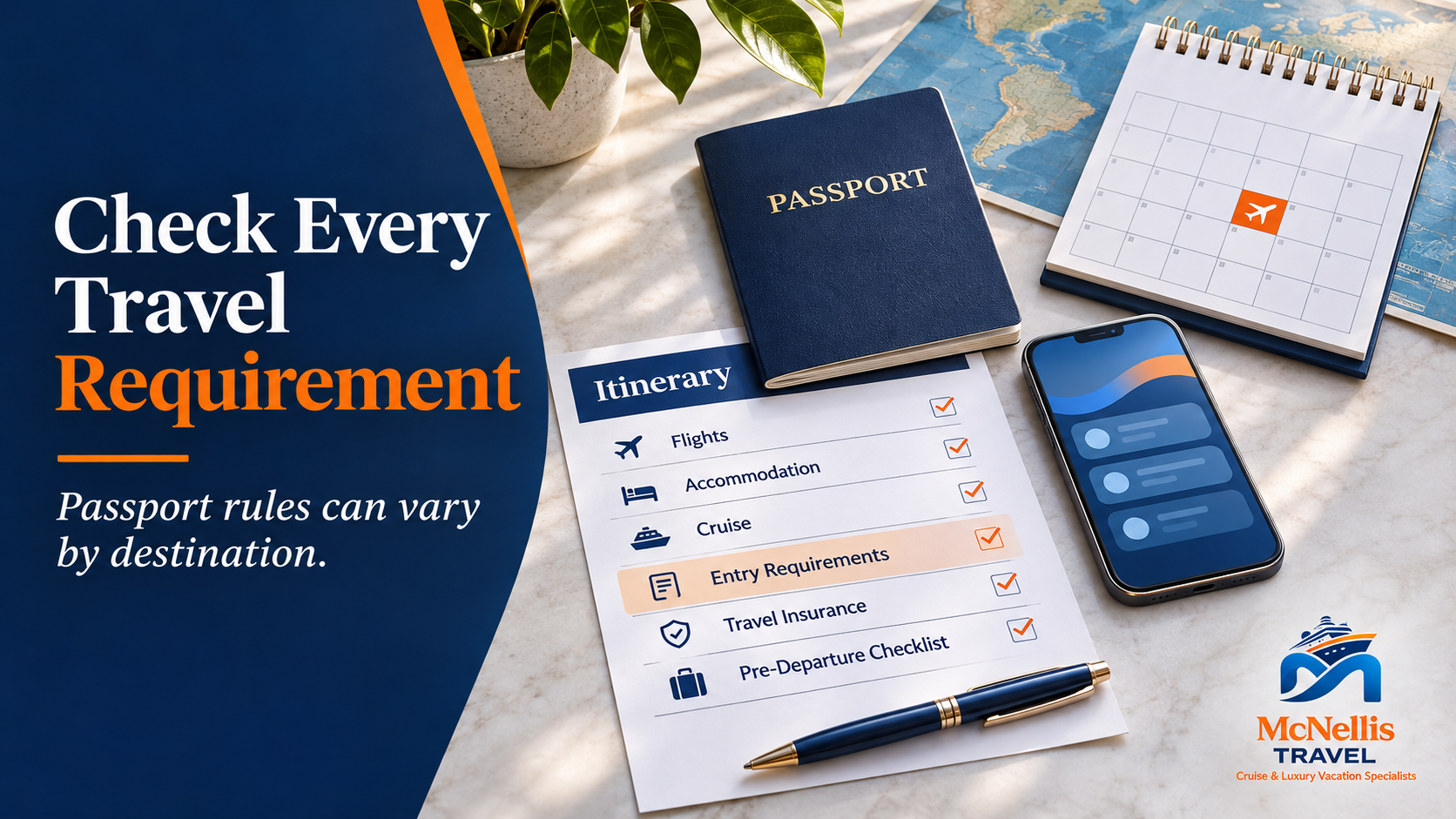
Mistake 4: Assuming a Valid Passport Is Automatically Valid for the Trip
A passport can be unexpired and still fail to meet a destination’s entry requirements. Some countries require additional validity beyond the travel dates, while others apply different rules. Travelers may also need a visa, electronic authorization, proof of onward travel, empty passport pages or documentation for a child traveling without both parents.
There is no universal rule that every passport must remain valid for six months after every international trip. Some destinations use six months, some use a shorter period and others require validity only for the planned stay. The requirement must be checked for the traveler’s nationality, destination, transit countries and itinerary.
Start reviewing documents when planning begins, not during online check-in. Confirm the following for every traveler:
Passport expiration date and condition
Destination-specific validity requirement
Visa or electronic travel-authorization requirement
Rules for every country used in transit
Available blank pages when required
Name match between identification and reservations
Consent or custody documents for children when applicable
Health, customs or arrival forms required before travel
U.S. travelers should use the U.S. Department of State’s destination and document guidance. Canadian travelers should review the destination’s current entry and exit requirements through Travel.gc.ca.
Airlines and border authorities make the final determination. A social-media post, old screenshot or previous visit is not proof that the same rule still applies.
Mistake 5: Building a Flight Itinerary That Works Only When Everything Is On Time
A connection that technically meets an airline’s minimum connecting time may still be uncomfortable for a particular traveler. Large terminals, immigration, security, mobility needs, children, checked luggage, weather and unfamiliar airport layouts can turn a legal connection into a fragile one.
Minimum connecting time is not a recommendation that every traveler should accept. It is an operational threshold used for a particular airport, airline and itinerary.
Look beyond the minutes displayed between flights. Ask whether the connection requires a terminal change, another security screening, immigration, baggage collection or transportation between airports. Consider what happens if the first flight arrives late and how many later flights could still reach the destination that day.
Separate tickets require extra caution. When flights are purchased independently, the second airline may have no obligation to accommodate the traveler after a missed connection caused by the first flight. Checked luggage may also need to be collected and rechecked. The apparent savings should be weighed against the cost of a replacement ticket, hotel and missed vacation time.
Travelers connecting to a cruise, wedding, guided tour or other fixed event should build in additional protection. Arriving the day before is often sensible when missing the departure would have serious consequences, although the appropriate buffer depends on the itinerary.
For complicated routes, our guide to booking multi-city trips without unnecessary stress explains how to sequence flights, hotels and ground transportation as one coordinated itinerary.

Mistake 6: Assuming Travel Insurance Covers Every Reason for Cancelling
Travel insurance is not one standardized product. Policies differ in their covered reasons, exclusions, benefit limits, documentation requirements and deadlines. Buying a policy without reading the certificate can create confidence without providing the expected protection.
Trip-cancellation coverage normally applies only when the cancellation results from a reason identified in the policy. Changing your mind, becoming uncomfortable about traveling or deciding the trip is no longer affordable may not qualify under a standard plan. Cancel-for-any-reason coverage, when available, usually has its own purchase deadlines, reimbursement limits and conditions.
Medical coverage also requires careful review. A traveler’s regular health insurance may provide limited or no coverage outside the home country. Emergency medical treatment and medical evacuation are separate concerns, particularly for cruises, safaris, remote destinations and trips involving limited local care.
Before purchasing a policy, compare:
The travelers and trip costs being insured
Covered cancellation and interruption reasons
Emergency medical limits
Medical evacuation and repatriation benefits
Pre-existing-condition requirements or waivers
Coverage for planned sports and activities
Delay and missed-connection benefits
Baggage limits and exclusions
Supplier-default provisions
Purchase and claim-filing deadlines
Travel insurance cannot prevent a disruption. Its purpose is to reduce specified financial risks and provide assistance when a covered event occurs. The correct policy depends on the trip, the travelers and the expenses that would be difficult to absorb.
These first six mistakes occur before the traveler reaches the airport, but they influence almost everything that follows. Part Two will address packing, medication, money, mobile access and the small preparation failures that become expensive once the trip has begun.
Three-question check
Does Part Two repeat Part One or another article?No. It addresses preparation after booking. The security-checkpoint details remain in the separate airport-security guide.
Can it be tightened?Yes. I removed arbitrary packing formulas and generic advice that would not apply to every traveler.
Is it polished and ready, or can I do better?It is polished and ready. Medication and financial guidance was checked against current government and public-health sources. CDC Yellow Book™
Mistake 7: Packing for Every Possibility Instead of the Actual Trip
Overpacking often begins with reasonable concerns. The weather might change. A restaurant may require different clothing. Something important could be difficult to replace. The result is a suitcase built around unlikely possibilities rather than the itinerary.
A useful packing list begins with what the traveler will actually do. Review the destination, forecast, cultural expectations, planned activities, laundry access and luggage restrictions. Clothing should work in combinations rather than as isolated outfits, but there is no universal formula dictating how many tops, bottoms or shoes every traveler needs.
Footwear deserves particular discipline because it consumes space and weight quickly. Bring shoes that match confirmed activities and that have already been worn comfortably. A new pair that causes blisters can affect several days of sightseeing.
The same principle applies to specialty equipment. Snorkeling gear, formalwear, hiking equipment, baby supplies and mobility aids may be essential for one itinerary and unnecessary for another. Confirm what the hotel, cruise line, tour operator or rental provider supplies before carrying duplicates.
Leave enough room for practical needs and the return journey. An overfilled suitcase is harder to reorganize, more likely to exceed weight limits and leaves no flexibility for purchases or unexpected changes.
Mistake 8: Putting Every Essential Item in Checked Luggage
Checked luggage can be delayed, misrouted or inaccessible during a long disruption.
Travelers should pack the carry-on around what they would need if the checked bag did not arrive with them.
That does not mean trying to reproduce the entire suitcase. It means protecting the items that are difficult, expensive or unsafe to replace quickly.
Essential carry-on items may include:
Passports, identification and required travel documents
Medication and necessary medical supplies
Wallet, payment cards and a small amount of appropriate cash
Phone, charging cable and portable battery that complies with airline rules
Valuables and fragile electronics
Insurance and emergency contact information
One practical change of clothing
Basic toiletries within current screening limits
Essential feeding supplies and infant items
Anything required during the first day of the trip
Cruise passengers should also keep documentation, medication, swimwear and dinner-appropriate clothing accessible because checked bags may not reach the cabin immediately after boarding.
A copy of important documents can be useful, but it should be stored securely and separately from the originals. Digital copies should be protected rather than left openly accessible in a photo gallery or email account.
Families flying with children can use our airport-security guide for children for detailed information about identification, feeding supplies, medication, strollers and screening.
This article focuses on broader trip preparation rather than repeating those checkpoint procedures.

Mistake 9: Treating Medication Like Ordinary Luggage
Medication requires more planning than placing a pill organizer in a suitcase. A prescription that is legal and commonly used at home may be restricted in another country. This is particularly important for controlled medications, certain pain treatments, ADHD medication, sleeping medication, medical cannabis and drugs containing ingredients regulated differently abroad.
Check the rules for every destination and transit country. An airport connection can still place the traveler under another country’s laws, even when they do not plan to leave the terminal. When official information is unclear, contact the appropriate embassy or consulate rather than relying on a discussion forum.
Medication should generally remain in its original, pharmacy-labelled packaging. Bring copies of prescriptions and, when appropriate, a letter from the prescribing clinician describing the medication and medical need. Documentation requirements vary, so confirm whether translation, advance permission or a particular certificate is required.
Carry essential medication and supplies in hand luggage during transportation. Bring enough for the planned trip plus a reasonable delay, while respecting any destination limits on the quantity permitted. Travelers using temperature-sensitive medication should confirm storage arrangements during flights, transfers and hotel stays rather than assuming a minibar provides medical-grade refrigeration.
Time-zone changes may affect dosing schedules. Discuss the adjustment with the prescribing clinician or pharmacist before departure, especially when the timing of a medication is medically important.
Do not assume an identical brand or dosage will be readily available abroad. The generic name, formulation and prescribing rules may differ, and purchasing medicine from an unverified source introduces additional risks.
Mistake 10: Depending on One Payment Method
A single lost, damaged, blocked or compromised card can leave a traveler unable to pay for transportation, food or accommodation. Carry at least two suitable payment methods and store them separately.
Before departure, review each card’s foreign-transaction fees, international ATM charges, daily withdrawal limits and emergency-replacement process. A card that earns travel points may still be an expensive choice abroad if its fees offset the rewards.
Use ATMs attached to established financial institutions when practical, inspect the machine before inserting a card and decline assistance from strangers. Fees can come from both the local ATM operator and the traveler’s own financial institution, so one withdrawal may involve more than one charge.
When a card terminal or ATM offers to convert a purchase into the traveler’s home currency, pause before accepting. This service is commonly called dynamic currency conversion. The exchange rate and markup may be less favourable than allowing the card network to process the transaction in local currency. Travelers should review their own card terms and understand the displayed conversion before choosing.
Cash remains useful for tips, markets, transportation and small businesses, but carrying the entire vacation budget in cash creates unnecessary risk. Exchange only what is reasonably needed and avoid displaying or repeatedly counting money in public.
Keep the financial institution’s international contact number somewhere other than the back of the card. If the card disappears, the traveler still needs a way to report it.
Mistake 11: Arriving Without a Mobile and Communication Plan
A working phone has become part of the travel infrastructure. It may be needed for airline updates, hotel messages, digital boarding passes, navigation, transportation apps, two-factor authentication and contact with the travel advisor.
Before departure, determine whether the current carrier offers an international plan, daily roaming, regional coverage or no useful service at the destination. Compare that with a local SIM or eSIM when the phone is compatible and unlocked.
Do not assume airport, hotel or restaurant Wi-Fi will be fast, secure or available exactly when needed. Download essential information before leaving home:
Airline and accommodation details
Transfer instructions
Offline maps
Insurance information
Emergency contacts
Copies of the itinerary
Relevant transportation apps
Translation tools or language files
Tickets that can be stored offline
Public Wi-Fi should not be treated as automatically secure. Avoid accessing sensitive financial information over an untrusted network, keep devices updated and use screen locks and account protections.
Travelers relying on text-message authentication should confirm whether their home number will still receive messages abroad. Losing access to a banking, airline or email account because the verification method does not work can become a serious problem.
Groups should also agree on a communication plan. Decide which app everyone will use, how often messages will be checked and what to do if someone loses service or becomes separated.
Mistake 12: Using One Airport-Arrival Rule for Every Flight
“Two hours for domestic and three hours for international” is a familiar starting point, but it is not a universal guarantee. The appropriate arrival time depends on the airport, airline, departure period, luggage, screening needs and itinerary.
Begin with the current recommendation from the operating airline and departure airport. Then consider the circumstances that may require additional time:
Holiday or peak-period travel
Checked luggage or oversized equipment
International document verification
Children, strollers or car seats
Mobility or medical assistance
Group check-in
Unfamiliar terminals
Parking and shuttle transportation
Rental-car return
Passport-control or exit procedures
A fixed departure such as a cruise or tour
Confirm the terminal before leaving and allow for the time required to move from parking, a hotel shuttle or public transportation to the check-in area. “Arriving at the airport” is not the same as standing at the correct airline counter.
Travelers using a trusted-traveler or expedited-screening program should not build an itinerary that fails if the faster lane is unavailable. Eligibility can vary by boarding pass, airport, terminal and operating conditions.
Once through security, check the gate again. Airports sometimes change gates or use separate concourses that require additional walking or transportation.

Mistake 13: Failing to Prepare for the First 24 Hours
The first day of a trip is vulnerable to delays, fatigue and small communication failures. Travelers often plan the entire vacation yet leave the arrival period surprisingly vague.
Know how you will reach the accommodation, whether the transfer is prepaid, where the driver will meet you and whom to contact if the flight is delayed. Confirm the accommodation address and check-in procedure, particularly for villas, apartments and properties without a 24-hour front desk.
Do not schedule an expensive non-refundable activity immediately after arrival. Immigration, luggage and ground transportation can take longer than expected, and the traveler may be tired even when every flight operates normally.
Identify a practical first meal and keep enough payment flexibility for transportation, food or an unexpected hotel change. Families should make sure children have access to medication, feeding supplies, comfort items and sleepwear without unpacking every suitcase.
A simple first-day plan protects the rest of the itinerary. It gives the traveler room to absorb a delay without turning the opening hours of the vacation into a chain of missed reservations.
Part Three will address the mistakes travelers make during the vacation itself: overscheduling, ignoring local conditions, handling disruptions poorly, losing control of documents and failing to protect the return journey.
Mistake 14: Scheduling Every Hour of the Vacation
A full itinerary can look impressive before departure and feel exhausting once the trip begins. Travelers often underestimate the time consumed by breakfast, transportation, ticket collection, security lines, finding meeting points and moving a group from one place to another.
The problem becomes greater when several demanding days are placed together. A late arrival followed by an early tour, a full sightseeing day and an evening reservation may leave the traveler tired before the vacation has properly started.
Decide which experiences are genuinely important and build the schedule around them. One primary activity per day may be enough for a family, large group or traveler managing mobility or health concerns. Couples and active adults may comfortably do more, but they still need realistic transit and meal time.
Avoid treating free time as wasted time. An unscheduled afternoon can absorb a delayed tour, poor weather or simple fatigue without forcing the traveler to cancel something expensive.
When an activity requires advance reservations, confirm the meeting point, arrival time, dress requirements, physical demands and cancellation terms. “Three-hour tour” may not include transportation to and from the departure point.
The goal is not to do as little as possible. It is to protect the experiences that matter from an itinerary too crowded to enjoy them.
Mistake 15: Ignoring Local Conditions After Arrival
Research should not end when the flight lands. Weather, transportation, strikes, demonstrations, wildfires, storms, road closures, marine conditions and local events can affect plans with little notice.
Check reliable local and official sources throughout the trip. A forecast viewed a week earlier may no longer apply. Conditions at a beach, mountain, park or port can be very different from conditions at the hotel.
Follow closures and safety instructions even when other visitors appear to ignore them.
A red beach flag, closed trail or cancelled boat departure is not an invitation to find an unofficial alternative.
Travelers should also respect local customs rather than assuming resort behaviour is appropriate everywhere. Clothing, photography, public displays, alcohol, tipping and access to religious or cultural sites may be handled differently from home. When unsure, ask a reputable local guide or accommodation representative.
Situational awareness does not require approaching every destination with fear. It means paying attention, using appropriate transportation, protecting belongings and adjusting plans when current conditions make the original itinerary unwise.
Mistake 16: Carrying Every Important Item Together
A wallet containing every payment card, all available cash and the only copy of an identification document creates one point of failure. If it is lost or stolen, several problems occur at once.
Separate primary and backup resources. Keep a second payment method in a secure location and avoid carrying more cash than the day reasonably requires. Passports should be stored according to the circumstances and destination rather than automatically carried everywhere or automatically left in an unsecured room.
Do not leave identification, phones, wallets or medication unattended on a beach chair, restaurant table or rental vehicle seat. A locked hotel safe can provide useful protection, but travelers should still follow the property’s instructions and understand that no storage method removes every risk.
Store emergency contact information somewhere accessible without the missing phone or wallet. Include the financial institution, insurer, accommodation, airline, travel advisor and appropriate government assistance information.
Document copies can help with reporting and replacement, but a photocopy does not replace a passport where the original is legally required. Keep digital copies protected and avoid sharing sensitive documents through unsecured messages.
Mistake 17: Waiting Too Long to Report a Problem
A missing bag, incorrect room, cancelled transfer or serious delay rarely becomes easier to resolve after several days. Report the issue to the responsible provider promptly and create a clear record of what happened.
Be specific. Instead of saying the room is unacceptable, identify the confirmed room category and the feature that does not match the reservation. For a cancelled transfer, provide the booking number, scheduled pickup time, flight information and attempts already made to contact the operator.
Take photographs when they accurately document the problem. Save receipts, messages, cancellation notices, baggage reports and the names or reference numbers provided by staff. These records may be required by the supplier, insurer or payment provider.
Give the responsible company a reasonable opportunity to correct the issue while the traveler is still on location. Leaving the property, arranging an expensive alternative and requesting reimbursement later can complicate a claim if the original provider was not informed or allowed to respond.
Urgent health or safety problems are different. Move to a safe location and seek appropriate assistance first. The financial and administrative questions can follow.
Mistake 18: Reacting to a Disruption Without Understanding the Options
A cancellation or major delay creates pressure to accept the first available solution.
Before agreeing, understand what is being offered and what accepting it means.
For a disrupted flight, determine whether the airline is offering rebooking, a refund, travel credit or another arrangement. Ask about checked luggage and whether confirmed onward flights remain active. Do not cancel an entire itinerary from an airline app without understanding whether it will also cancel usable return segments.
If a cruise, tour, transfer or hotel is affected, contact the provider responsible for that component and inform the travel advisor when the booking was made through one.
Avoid sending separate instructions to several parties at once because conflicting changes can make the reservation harder to manage.
Insurance assistance and supplier customer service are not interchangeable. The airline may handle rebooking, the hotel may address accommodation and the insurer may later evaluate eligible expenses under the policy. Keep a record of what each party says.
Do not assume every meal, hotel night or replacement ticket will be reimbursed. Ask what the provider is authorizing, save itemized receipts and review the policy or applicable passenger protections.
Calm, organized communication does not guarantee the preferred outcome, but it reduces the chance of making the disruption more expensive.
Mistake 19: Treating Food, Water and Sun Exposure as Minor Concerns
Travelers sometimes take greater risks on vacation than they would at home. Heat, dehydration, unfamiliar food, alcohol, disrupted sleep and physical activity can combine quickly.
Drink appropriate water for the destination, pace alcohol consumption and protect against sun exposure even on cloudy days. A long excursion may require more water and food than expected, particularly when shade and restrooms are limited.
Travelers with allergies, diabetes, gastrointestinal conditions or other dietary needs should not assume every restaurant or tour operator will understand a brief explanation.
Carry translated information when useful and communicate serious allergies clearly.
Food-safety risks vary by destination and setting. Choose busy, reputable establishments, observe basic hygiene and follow current destination-specific health guidance. Street food is not automatically unsafe, and an expensive restaurant is not automatically risk-free.
Do not continue a strenuous activity simply because it was prepaid. Weather, illness, altitude, pain or exhaustion can change what is sensible. The cost of one missed activity is smaller than the cost of a medical emergency.
Mistake 20: Forgetting That the Return Journey Is Part of the Trip
The final travel day deserves the same attention as the outbound journey. Confirm the return flight, departure terminal, transfer time and luggage requirements before the last evening.
International departures may involve document checks or procedures that differ from the arrival experience. Airport traffic, ferry schedules, rental-car returns and resort checkout can affect when the traveler needs to leave.
Keep the final night under control. A late celebration followed by an early transfer increases the chance of lost belongings, missed alarms and forgotten documents. Pack most of the luggage before the last evening and complete a deliberate room check before departure.
Look inside the safe, drawers, charging outlets, bathroom, closet, refrigerator and balcony. Count passports, payment cards, medication, phones, chargers and bags before leaving the property.
Keep essential items in the carry-on again. Medication, documents and valuables should not move into checked luggage simply because the vacation is almost over.
After returning home, review payment-card activity, submit eligible insurance or baggage claims promptly and retain travel records until outstanding issues are resolved.

What to Do When Something Goes Wrong
When a problem occurs, use a simple order of response:
Protect people first. Move away from immediate danger and obtain medical, police or emergency assistance when required.
Identify the responsible provider. Determine whether the airline, hotel, cruise line, tour operator, transfer company or insurer needs to act first.
Document the problem. Save photographs, receipts, notices, messages and reference numbers.
Communicate clearly. Provide the reservation number, facts, requested solution and best way to reach you.
Understand the proposed resolution. Ask what will happen to the remaining reservation before accepting or cancelling anything.
Inform the travel advisor. When the trip was booked through an advisor, provide the relevant facts and documents rather than beginning several conflicting changes independently.
Keep expenses reasonable. A policy or supplier may reimburse only eligible and documented costs.
A travel advisor can help interpret reservations, contact suppliers and organize next steps, but cannot override border authorities, force a supplier to provide inventory or guarantee an insurance claim. Our article explaining what personalized travel planning really saves describes that role in more detail.
Final Travel Mistake Prevention Checklist
Before paying a deposit:
Confirm that the trip fits the travelers rather than merely offering an attractive price.
Compare the complete cost.
Check flights, transfers and accommodation together.
Review cancellation and change conditions.
Consider suitable travel insurance before applicable deadlines.
Before departure:
Recheck passports, visas, authorizations and transit requirements.
Verify names, airports, dates and room categories.
Confirm medication rules and documentation.
Pack essential items in carry-on luggage.
Arrange suitable phone access and backup payments.
Download the itinerary and important contact information.
Review airport and airline recommendations.
Confirm arrival transportation and first-day plans.
During the vacation:
Monitor current local conditions.
Leave room in the itinerary for rest and delays.
Protect documents, medication and payment methods.
Report problems promptly.
Save receipts and written records.
Understand a proposed resolution before accepting it.
Reconfirm the return journey.
Frequently Asked Questions About Avoiding Travel Mistakes
What is the most expensive common travel mistake?
Booking non-refundable components before confirming that the entire itinerary works can be especially costly. Missed connections, incorrect dates, unsuitable rooms and impossible transfers may affect several reservations at once.
How often should travelers recheck entry requirements?
Check when planning begins, again before making major non-refundable payments and once more close to departure. Requirements can change, and every destination and transit country must be considered.
Should essential medication ever go in checked luggage?
Essential medication should generally remain accessible in carry-on luggage during transportation. Travelers should follow airline, security and destination rules and confirm any special handling required for liquids, needles, refrigeration or medical equipment.
Is the cheapest travel-insurance policy good enough?
Only if its coverage, limits and exclusions match the trip and travelers. Price alone does not establish whether the policy covers the risks that matter.
Are separate airline tickets always a mistake?
No. They can sometimes provide useful routes or savings. The traveler must understand that baggage handling, connection protection and rebooking responsibilities may differ from a through-ticket itinerary.
How much free time should an itinerary include?
There is no universal amount. The itinerary should reflect the travelers’ energy, mobility, interests and transportation demands. Large groups and families generally need more flexibility than a pair of experienced independent travelers.
Can a travel advisor prevent every problem?
No. Weather, airline operations, border decisions and supplier availability remain outside an advisor’s control. An advisor can reduce avoidable planning errors, help compare options and provide informed assistance when a problem occurs.
Better Travel Begins Before Departure
Avoiding travel mistakes is not about controlling every moment. It is about making informed decisions while options remain available, protecting the parts of the trip that matter and knowing how to respond when plans change.
The most effective preparation is specific. It reflects the destination, travelers, itinerary and financial risk rather than relying on a universal packing rule or advice remembered from a previous trip.
Travel With McNellis helps individuals, couples, families and groups compare destinations, cruises, resorts, flights, rooms, transfers and important booking conditions as one coordinated vacation. When you are ready to plan with fewer assumptions and a clearer understanding of the details, contact Travel With McNellis to begin.