MARGE’S TRAVEL INSIGHTS
Mediterranean Cruise Ports Ranked: What Each Stop Is Really Like
Discover the best Mediterranean cruise ports ranked by experience, accessibility, and value. Learn what each stop is really like before you book.
Updated August 2026: This guide has been completely rebuilt and expanded to give travelers a more realistic look at Mediterranean cruise ports. We now rank 18 major ports based on the actual cruise-day experience, including port logistics, cultural value, crowds, accessibility, independent exploration, current traveler considerations, and whether the destination is worth choosing an itinerary for.
Mediterranean cruise itineraries can look almost impossible to compare.
One sailing promises Barcelona, Rome and Naples. Another combines Athens, Santorini and Mykonos. A third adds Croatia, Malta or Türkiye. On paper, nearly every itinerary looks extraordinary.
Once you arrive, however, Mediterranean cruise ports are very different from one another.
Some put you within walking distance of a historic city. Others leave you an hour or more from the destination printed on the itinerary. Some are ideal for independent exploration. Others require careful transportation planning, timed admission tickets or a guided excursion simply to make good use of a limited port day.
Then there is the part that cruise brochures rarely explain: what the destination actually feels like once you are there.
A port can be beautiful and still be frustrating. A famous city may deserve several days rather than seven hurried hours. A less celebrated stop can become the highlight of the cruise because the ship arrives almost directly in the middle of the experience.
Culture matters too.
You are not simply stepping off a ship to photograph monuments. You are entering communities with their own languages, histories, religious traditions, eating habits, social expectations and attitudes toward tourism. Understanding even a little of that before you arrive can turn an ordinary shore excursion into a meaningful travel experience.
That is what this ranking is about.
It is not a list of the Mediterranean's most photogenic places. It is a ranking of
Mediterranean cruise ports as actual cruise ports.
Travelers who are still deciding between ships, cruise lines and Mediterranean routes can also explore McNellis Travel's full cruise vacation options before choosing an itinerary. Explore McNellis Travel cruise vacations
How We Ranked the Best Mediterranean Cruise Ports
Every port was considered using the same broad criteria:
Overall destination experience
Port-to-attraction logistics
Cultural and historical value
Ease of independent exploration
Scenery and atmosphere
Amount you can realistically experience during one port call
Crowds and tourism pressure
Traveler considerations, including mobility, current security guidance, local laws or customs when materially relevant
The ranking does not mean the number-one port is automatically right for every traveler.
Someone fascinated by archaeology may choose Kuşadası specifically because of Ephesus. A traveler who dislikes crowds may prefer Valletta to Santorini. Someone with limited mobility may evaluate Dubrovnik very differently from an active traveler who enjoys stairs and steep streets.
Use the rankings as a starting point, then look closely at the details that matter to you.
Mediterranean Cruise Port Rankings at a Glance
Rank
Cruise Port
Why It Stands Out
#1
Barcelona, Spain
Exceptional combination of culture, food, architecture and cruise convenience
#2
Istanbul, Türkiye
Extraordinary depth, history and cultural contrast
#3
Valletta, Malta
Compact, beautiful and remarkably rewarding during a single port day
#4
Santorini, Greece
Spectacular scenery balanced by difficult crowd and tender logistics
#5
Athens/Piraeus, Greece
One of the Mediterranean's great historical experiences
#6
French Riviera
Beautiful coastal choices with several very different ways to spend the day
#7
Naples, Italy
Intense, authentic and surrounded by world-class excursion possibilities
#8
Kuşadası/Ephesus, Türkiye
One of the strongest archaeological port days anywhere
#9
Dubrovnik, Croatia
Beautiful, accessible and historically compelling
#10
Civitavecchia/Rome, Italy
Rome is extraordinary; reaching it from the port is the challenge
#11
Livorno/Florence, Italy
Superb destinations with significant transportation demands
#12
Kotor, Montenegro
Dramatic scenery and an intimate historic center
#13
Palma de Mallorca, Spain
Easygoing combination of architecture, food and island atmosphere
#14
Mykonos, Greece
Beautiful but heavily shaped by tourism and seasonal crowds
#15
Split, Croatia
Easy access to history, waterfront life and Dalmatian culture
#16
Corfu, Greece
Attractive and relaxing, particularly for travelers wanting a softer port day
#17
Messina/Taormina, Sicily
Taormina is excellent; the port itself is largely a gateway
#18
Marseille, France
Interesting in its own right but often more valuable as a gateway to Provence
McNellis Travel's Mediterranean destination guide also compares cruise regions, islands, hotels and land extensions for travelers who want to look beyond an individual port call. Explore Mediterranean cruises and vacations
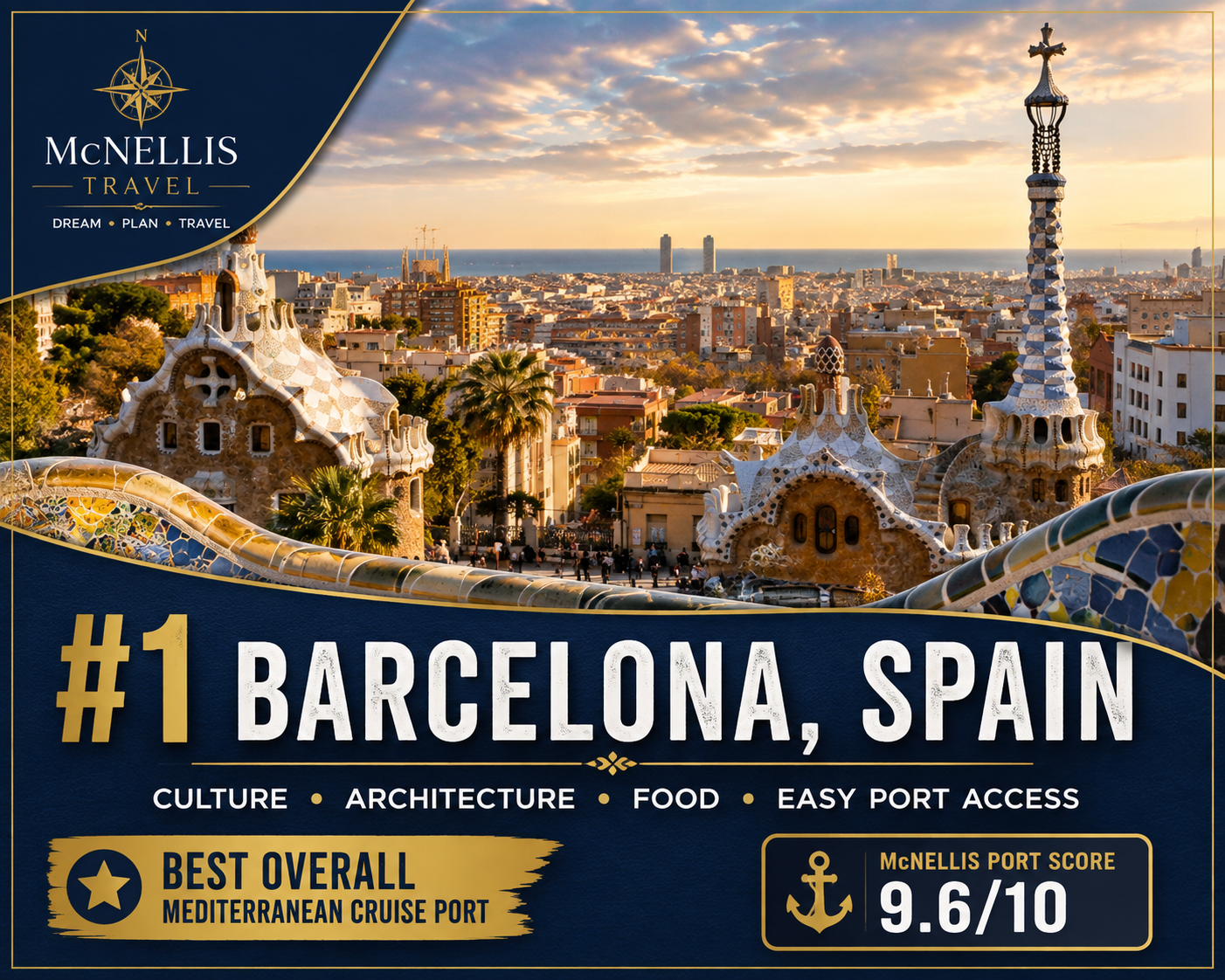
#1 Barcelona, Spain
What Barcelona Is Really Like From a Cruise Ship
Barcelona earns the top position because it delivers something surprisingly difficult to find in the Mediterranean: a major world city that is also genuinely practical as a cruise destination.
The port is close enough to the center that you do not sacrifice half your day reaching the attractions. Barcelona is also a major embarkation and disembarkation point, which makes it one of the best Mediterranean cities to extend with several hotel nights before or after a cruise.
The challenge is deciding what not to do.
Sagrada Família, the Gothic Quarter, Park Güell, La Boqueria, Casa Batlló, Montjuïc and the waterfront can easily fill several days. Trying to squeeze them all into one port call usually produces a checklist rather than an experience.
First-time visitors should choose two or three priorities and leave space to walk.
Experience the Culture: Understand That Barcelona Is Catalonia
The most important thing to understand before visiting Barcelona is that you are not simply visiting another Spanish city.
Barcelona is the capital of Catalonia, a region with its own language, history, traditions and strong cultural identity. You will see both Catalan and Spanish on signs, menus, transportation systems and public buildings. Many residents speak both languages.
You do not need to understand Catalan politics to travel respectfully, and a short cruise stop is certainly not the time to lecture residents about regional identity. Simply recognizing that Catalan culture exists—and treating it as something more than a tourist curiosity—already changes how you see the city.
Food provides one of the easiest ways to experience Barcelona beyond the landmarks.
Instead of treating La Rambla as the destination, step into neighborhoods such as the Gothic Quarter, El Born, Gràcia or parts of Eixample and notice how people actually use their city. Meals often happen later than many Americans expect. Lunch can be substantial. Dinner commonly begins after the hour at which many cruise passengers are already thinking about returning to the ship.
Seek out Catalan dishes and ingredients rather than assuming every meal needs to be paella and sangria. Try pa amb tomàquet, bread rubbed with tomato and olive oil; regional seafood; cured meats; local cheeses; crema catalana; or a simple vermouth accompanied by small plates.
Barcelona also rewards travelers who slow down enough to notice its everyday rituals. Sit at a neighborhood café. Walk through a municipal market that is not packed exclusively with tour groups. Look at the balconies, small plazas and architectural details between the famous buildings.
A few basic courtesies matter. Begin an interaction with a greeting rather than immediately launching into a request. Do not assume everyone working in hospitality wants to speak English, even though many do. Learning bon dia—good morning in Catalan—is a small gesture, not an expectation.
And remember that Barcelona is dealing with real concerns about overtourism and housing pressure. Residents are not part of the attraction. Treat residential streets and neighborhoods accordingly.
Know Before You Go
Barcelona's most common visitor problem is not navigating the port—it is protecting belongings in heavily visited areas and on public transportation.
As of August 2026, the U.S. Department of State lists Spain at Level 2: Exercise Increased Caution. Travelers should review current U.S. guidance before departure rather than assuming conditions remain unchanged.
Keep phones and wallets secure, especially around Las Ramblas, crowded Metro stations and major attractions. A crossbody bag held in front is more useful than becoming paranoid about everyone around you.
McNellis Port Verdict
Best for: First-time Mediterranean cruisers, architecture, food, city lovers and pre/post-cruise stays.
Potential drawback: Crowds and the temptation to schedule far too much.
Would we choose an itinerary because Barcelona is on it? Absolutely—especially when Barcelona is the embarkation or disembarkation city and you can add extra nights.
McNellis Port Score: 9.6/10
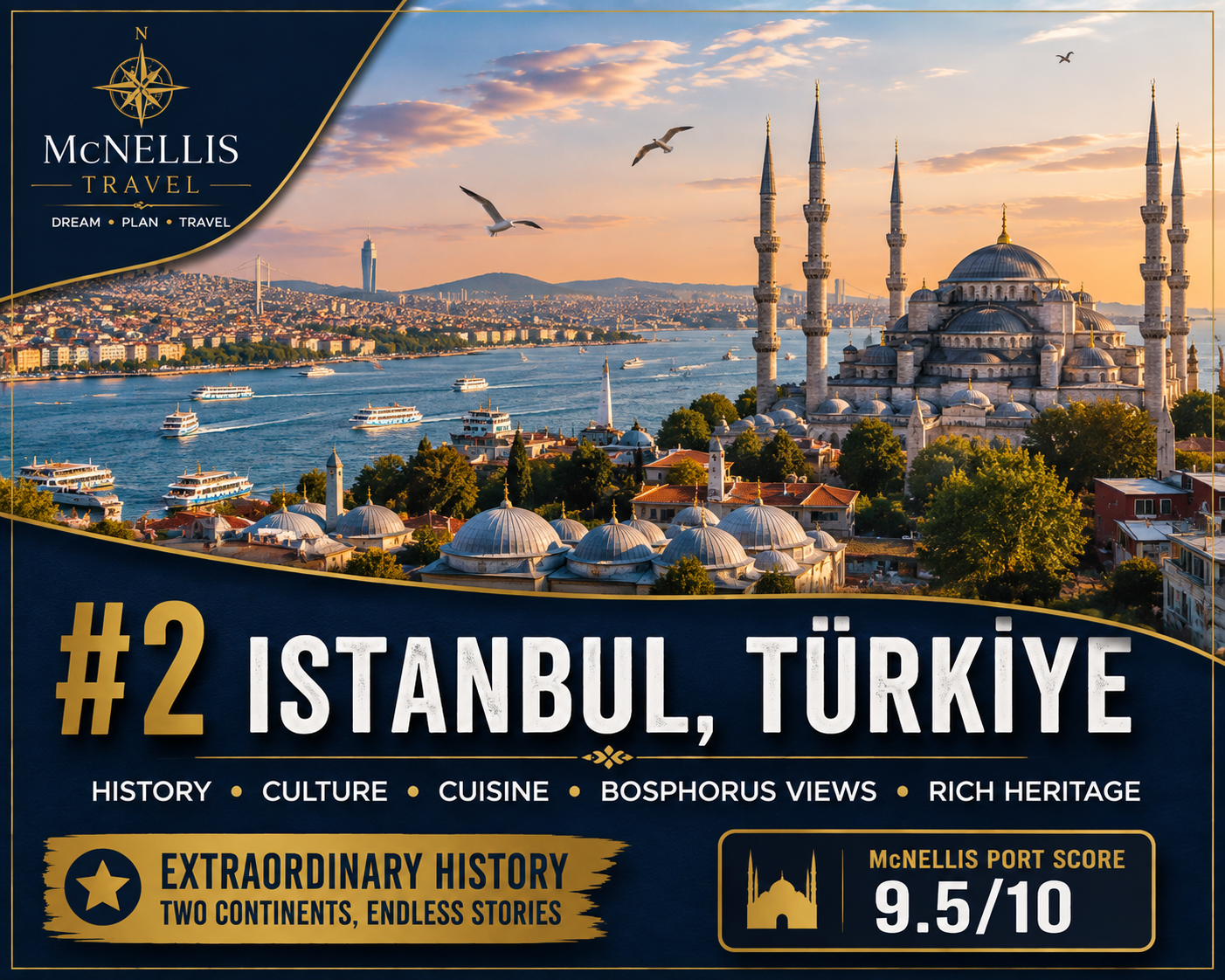
#2 Istanbul, Türkiye
What Istanbul Is Really Like From a Cruise Ship
Few Mediterranean ports create a sense of arrival like Istanbul.
The city stretches across Europe and Asia, divided by the Bosphorus and layered with Roman, Byzantine, Ottoman and modern Turkish history. Cruise passengers can move from the waterfront toward mosques, palaces, bazaars, neighborhoods and ferry routes that feel dramatically different from one another within the same day.
Istanbul's Galataport cruise terminal has made arriving considerably easier, but the city itself is enormous. Traffic can be heavy, attractions can have lines, and attempting to see everything from Hagia Sophia and the Blue Mosque to Topkapı Palace, the Grand Bazaar and a Bosphorus cruise in several hours is unrealistic.
Prioritize.
Experience the Culture: Istanbul Is More Than Its Monuments
Istanbul is one of those places where cultural awareness changes the entire experience.
This is a modern metropolis and an overwhelmingly Muslim city, but it cannot be understood through a simple East-versus-West stereotype. You will see conservative dress and contemporary fashion, centuries-old mosques and fashionable restaurants, traditional tea houses and modern nightlife, sometimes within a few streets of one another.
Start with hospitality.
Tea is woven deeply into everyday Turkish social life. You will see small tulip-shaped glasses of çay everywhere—from shops and cafés to offices and ferries. Accepting a tea when genuinely offered can create a small but memorable human interaction. It does not mean you are obligated to purchase something.
Food is another gateway. Move beyond the idea that Turkish cuisine means only kebabs. Depending on your limited port time, look for simit, meze, grilled fish, pide, börek, döner, Turkish coffee or regional sweets. A ferry crossing with tea in hand can feel more connected to Istanbul than rushing between three additional attractions.
Religious sites deserve deliberate respect.
At active mosques, dress requirements are not theatrical props for tourists. Visitors should follow posted instructions, remove shoes when required, cover shoulders and knees appropriately, and understand that women may be asked to cover their hair. Avoid walking in front of people who are praying, keep voices low and be prepared for tourist access to pause during prayer.
Photography should also involve judgment. A magnificent mosque interior is photographable; an individual worshipper in a private moment does not automatically become your subject.
The call to prayer is part of the city's rhythm. It may be unfamiliar to some American visitors, but experiencing it respectfully—particularly when several mosques answer across the city—is part of understanding where you are.
At bazaars, bargaining can be normal in certain shops, but the interaction should remain friendly. Negotiation is not an excuse to become aggressive over a few dollars.
And do not reduce modern Turks to the government, religion or whatever political debate is happening at home. Travelers can be aware of serious issues while still approaching individual residents with normal curiosity and respect.
Know Before You Go: Türkiye Requires a More Careful Conversation
As of August 2026, the U.S. Department of State lists Türkiye at Level 2: Exercise Increased Caution. The advisory cites terrorism and arbitrary detentions, with additional restrictions applying to certain areas of the country. Istanbul and Kuşadası are major tourist destinations, but U.S. travelers should still review the current advisory before travel.
LGBTQ+ travelers deserve particularly clear information.
In July 2026, Turkish authorities blocked an Atlantis Events LGBTQ+ charter aboard Virgin Voyages' Scarlet Lady from scheduled calls at Kuşadası and Istanbul. Reporting on the decision said authorities cited social and “moral values.” The incident affected nearly 2,000 passengers and forced the itinerary to be changed before the sailing reached Türkiye.
That does not mean an individual gay or lesbian traveler will automatically experience hostility in Istanbul, nor does it justify describing all Turkish people as unwelcoming. It does mean the incident is relevant information that LGBTQ+ travelers have a right to consider when deciding where and how they travel.
Public attitudes, official policies and individual experiences are not necessarily the same thing.
For all travelers, the sensible approach is simple: understand the laws and customs of the country you are entering, pay attention to current U.S. guidance and decide what level of comfort is appropriate for you.
McNellis Port Verdict
Best for: History, architecture, food, religious heritage and travelers who want genuine cultural contrast.
Potential drawback: Size, traffic, crowds and more significant cultural/security considerations than many European ports.
Would we choose an itinerary because Istanbul is on it? Yes. It is one of the world's great cities and deserves serious consideration—ideally with an overnight call or additional land stay.
McNellis Port Score: 9.5/10
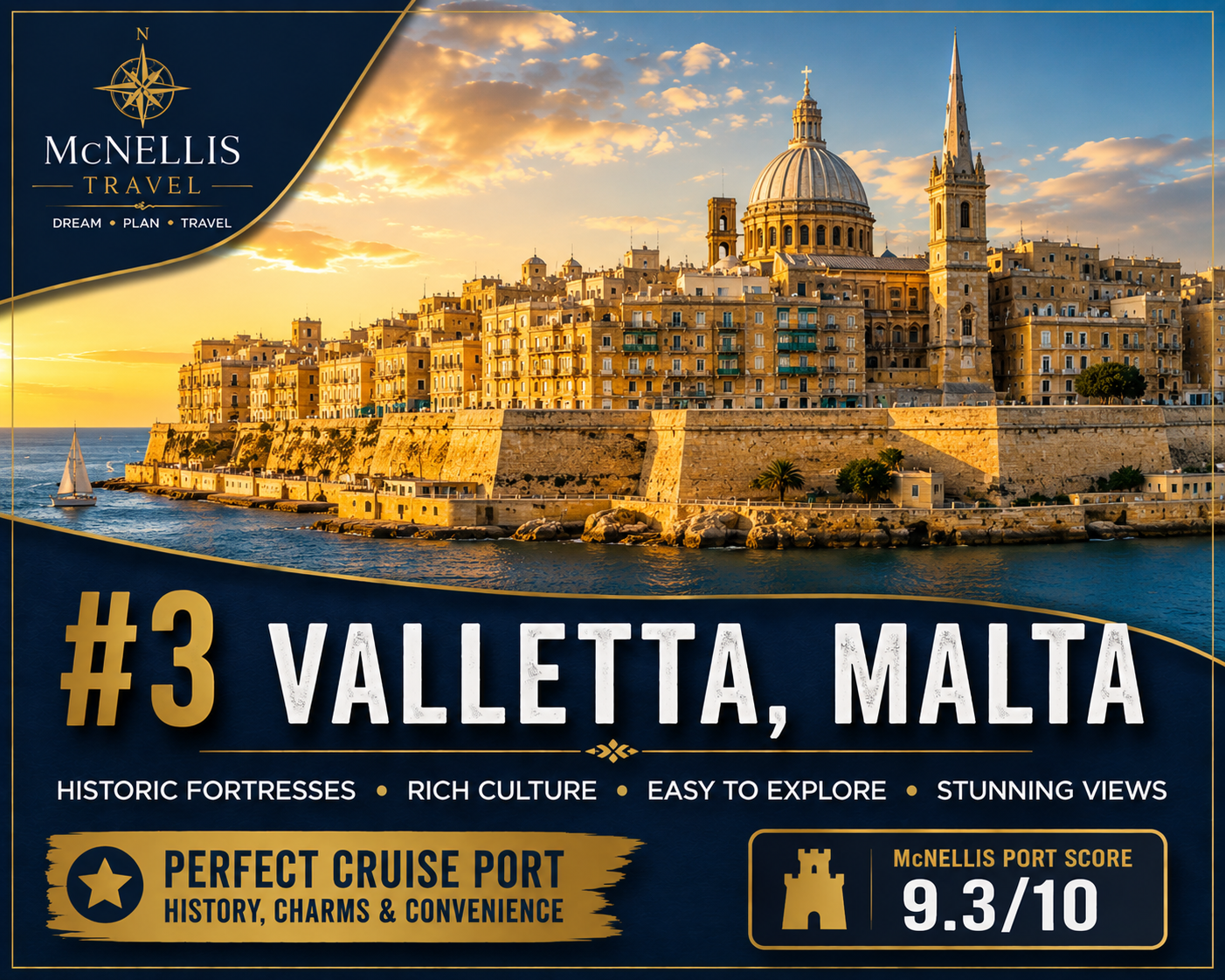
#3 Valletta, Malta
What Valletta Is Really Like From a Cruise Ship
Valletta is almost perfectly designed for a cruise day.
Ships arrive beneath massive honey-colored fortifications, and the historic city sits directly above the harbor. An elevator near the waterfront can help travelers reach the upper city, avoiding what would otherwise be a demanding climb.
Once above the harbor, much of central Valletta can be explored on foot.
That combination—dramatic arrival, minimal transfer time, genuine history and a compact center—is why Valletta ranks so highly.
Experience the Culture: Malta Is Its Own Mediterranean World
Malta sits between Europe and North Africa, and its culture reflects centuries of movement across the Mediterranean.
The Maltese language itself tells the story. Maltese is a Semitic language with historical
Arabic roots written in the Latin alphabet, while English is also an official language. Italian cultural influence is visible in food and media, British influence appears in everything from red telephone boxes to driving on the left, and Catholic traditions remain highly visible.
That blend makes Malta feel familiar and unfamiliar at the same time.
To experience Valletta culturally, pay attention to the limestone balconies, churches, side streets and small bars rather than using the city merely as a transfer point to another attraction.
St. John's Co-Cathedral is extraordinary, but it is also an active religious building.
Appropriate dress and quiet behavior matter. Malta's Catholic heritage is not confined to monuments; parish feasts, religious statues, processions and village traditions continue to play an important role in community life.
Food is another excellent entry point.
Try pastizzi, flaky pastries commonly filled with ricotta or peas. Look for ftira, Maltese bread and sandwiches, rabbit dishes, local cheeses, seafood and foods influenced by Sicily and North Africa. Rather than sitting immediately at the first restaurant facing the main tourist route, step down one of Valletta's side streets.
Malta also rewards curiosity about its military history. The island endured sieges, served as an important British naval base and played a major role during World War II. The story is not simply one of knights and medieval fortifications.
Speak to people.
Because English is widely spoken, Americans have an unusual opportunity here to ask questions and have genuine conversations without the language barrier found in many other Mediterranean stops. Ask about Malta rather than only asking where the next attraction is.
Valletta is also a functioning capital. Respect people going about their normal day, especially in residential streets. Beautiful enclosed balconies and stone façades may make every lane look like a movie set, but these are homes.
Know Before You Go
The U.S. State Department currently lists Malta at Level 1: Exercise Normal Precautions, with the advisory dated July 9, 2026.
The more common practical concerns involve heat, hills, uneven surfaces and stairs. Malta can be punishingly hot during summer. Plan walking realistically and use the waterfront elevator when it makes sense.
McNellis Port Verdict
Best for: History, architecture, independent explorers and travelers who dislike spending port days on buses.
Potential drawback: Heat and steep terrain.
Would we choose an itinerary because Valletta is included? Yes. It is one of the Mediterranean's most satisfying one-day cruise destinations.
McNellis Port Score: 9.3/10
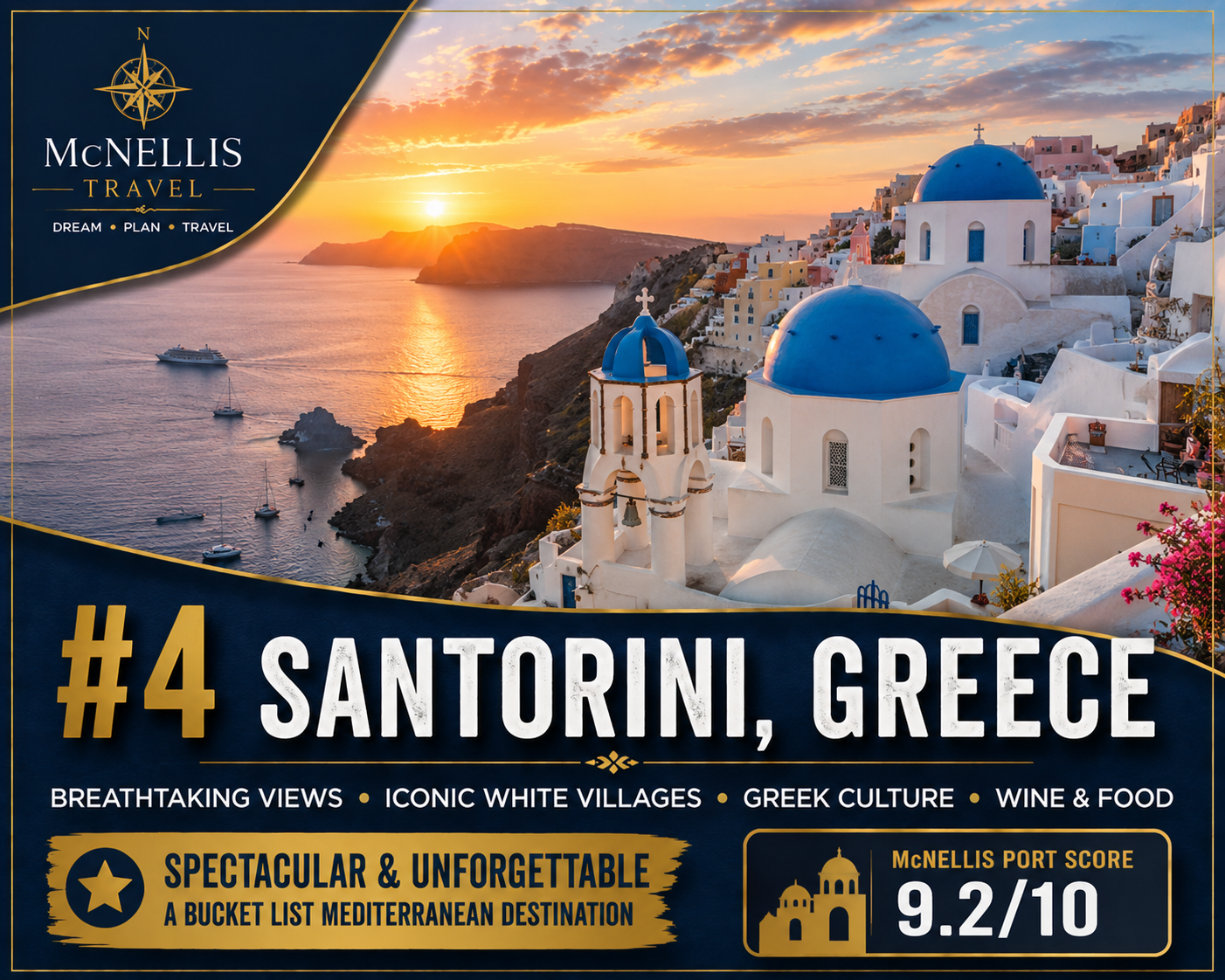
#4 Santorini, Greece
What Santorini Is Really Like From a Cruise Ship
Santorini may be the Mediterranean port where the difference between the photograph and the actual cruise-day experience is greatest.
The photographs are real.
The white villages hanging over a volcanic caldera are genuinely extraordinary.
But cruise passengers usually reach Santorini by tender. From the small port below Fira, travelers then need to ascend the cliff by cable car, walking path or excursion transportation arranged through another landing location.
When several ships arrive together, the bottleneck can become significant.
Santorini is still magnificent. It simply needs strategy.
Experience the Culture: Look Beyond the Blue Domes
Santorini's global fame can make it easy to forget that it is a Greek island with agricultural traditions, villages, churches, families and a history stretching far beyond Instagram.
The island's dramatic landscape was shaped by volcanic activity, and that geology influenced almost everything from settlement patterns to agriculture. Santorini's volcanic soil and dry climate help produce distinctive wines, especially from the Assyrtiko grape. Vines are traditionally trained low to the ground in basket-like formations that protect the fruit from strong winds.
That is culture you can actually experience.
A winery visit can provide more insight into Santorini than spending an hour waiting in line for one famous Oia photograph.
Food offers another route. Look for local tomatoes, fava made from yellow split peas, capers, white eggplant and seafood. Ask what is grown or produced on the island rather than automatically ordering the same generic Greek meal at every port.
Villages matter too.
Oia is beautiful, but it is not the only Santorini. Pyrgos, Megalochori and other communities can provide a different impression of the island, particularly when cruise crowds are concentrated in Fira and Oia.
Greek Orthodox churches should be treated as places of worship rather than photography studios. Follow dress expectations when entering, speak quietly and never interrupt a service simply because your excursion schedule is tight.
There is also an important behavioral point in heavily visited destinations like Santorini: do not treat residents' homes as props. Visitors climbing onto roofs, private terraces and church structures for photographs have created real frustration. A whitewashed rooftop may appear to be part of the scenery; it may also belong to someone.
A more meaningful Santorini visit comes from understanding why the island looks and lives the way it does—not merely collecting the view.
Know Before You Go
Greece is currently Level 1: Exercise Normal Precautions under U.S. State Department guidance.
Santorini's main challenges are operational: tender delays, cable-car queues, summer heat, steep walking routes and intense crowding when multiple ships overlap.
Travelers with mobility limitations should look closely at the day's transportation plan before booking excursions. The famous donkey route is steep, can be slippery and is not a sensible mobility workaround.
McNellis Port Verdict
Best for: Scenery, photography, couples, Greek island atmosphere and wine.
Potential drawback: Tender logistics and severe cruise-day crowding.
Would we choose an itinerary because Santorini is on it? Yes—but we would examine the ship schedule and port-day plan before booking.
McNellis Port Score: 9.2/10
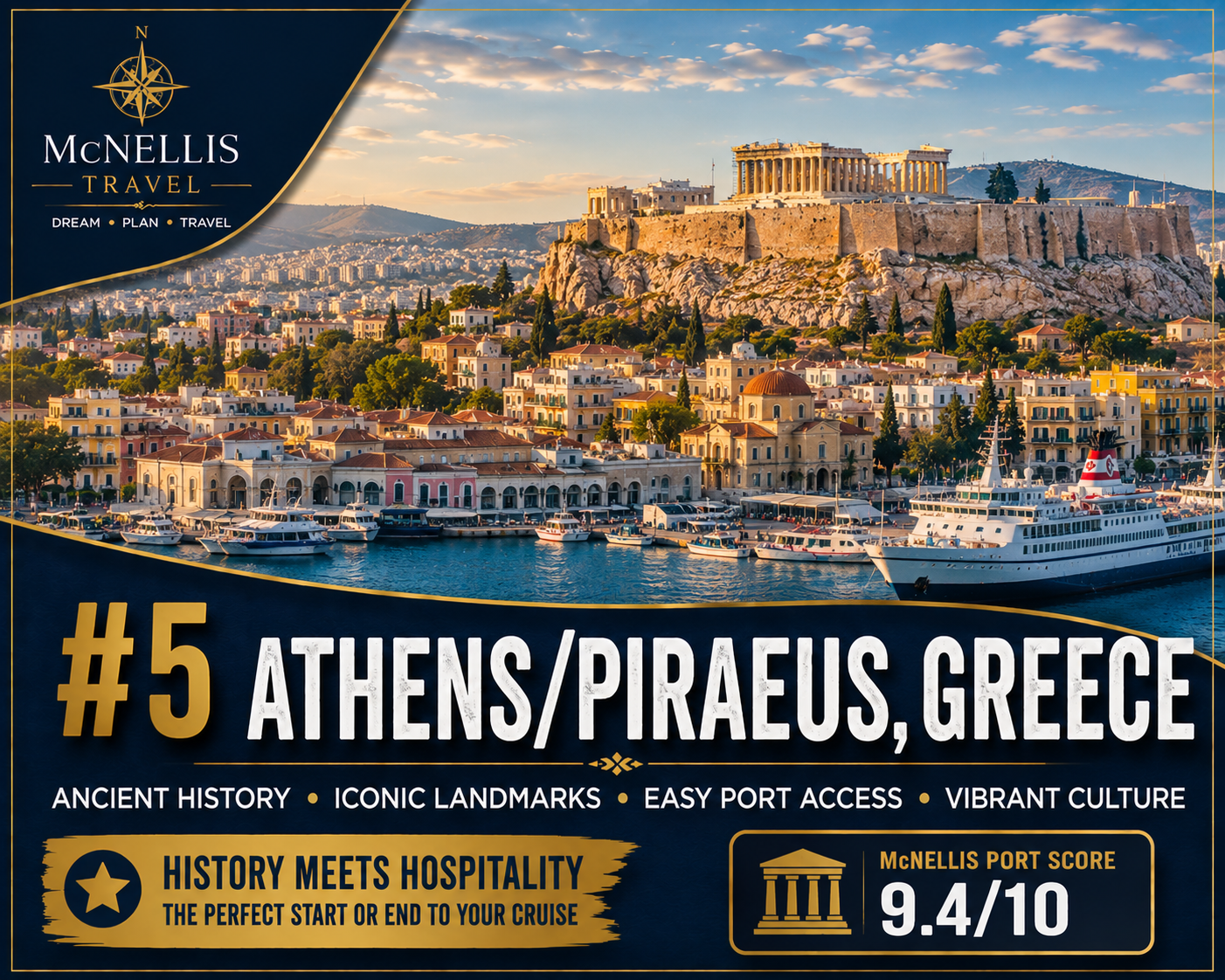
#5 Athens/Piraeus, Greece
What Athens Is Really Like From a Cruise Ship
Cruise ships dock at Piraeus, not beside the Acropolis.
Fortunately, the distance is manageable compared with ports such as Civitavecchia.
Depending on traffic and transportation choice, central Athens can generally be reached without consuming most of the day.
The real issue is scale.
The Acropolis alone deserves time. Add the Acropolis Museum, Ancient Agora, Plaka, Monastiraki, the Temple of Olympian Zeus and a Greek lunch, and the schedule can become ridiculous very quickly.
Choose a historical focus and give yourself time to absorb it.
Experience the Culture: Athens Is a Living City, Not an Archaeological Park
Athens is often introduced as the birthplace of democracy and then treated as if everything meaningful happened 2,500 years ago.
That misses the city.
Modern Athens is noisy, creative, argumentative, social and deeply connected to contemporary Greek life. The ancient monuments are extraordinary precisely because they exist inside a city that continued evolving around them.
Start by adjusting your pace.
Greek social life revolves heavily around conversation. Coffee is often something people sit with rather than consume while rushing down the street. Meals are social events. A table of friends may remain together much longer than an American visitor expects.
If your port schedule allows, leave enough space for that rhythm.
Food should go beyond ordering a gyro because you have arrived in Greece. Try dishes such as spanakopita, grilled fish, regional cheeses, vegetables cooked in olive oil, meze, souvlaki, yogurt and seasonal produce. Ask what is local or traditional at the restaurant rather than treating Greek cuisine as one fixed menu.
In neighborhoods such as Plaka and Monastiraki, tourism is unavoidable, but walking a little farther can show a more ordinary Athens. Observe small bakeries, produce markets, apartment balconies, cafés and neighborhood churches.
Religion remains culturally important. When entering Greek Orthodox churches or monasteries, behave as you would when visiting any active religious space: modest clothing, quiet voices and respect for worshippers.
Greeks can also be expressive conversationalists. Animated discussion does not necessarily mean conflict.
A few words such as kaliméra for good morning and efcharistó for thank you are appreciated, even though English is widely used in tourism.
And perhaps most importantly, do not approach contemporary Greeks as if they are museum interpreters for ancient Greece. Ask about modern food, neighborhoods, family life, islands, music or football. The Acropolis explains part of Greece's history. It does not explain every Greek person you meet.
Know Before You Go
The current U.S. advisory for Greece is Level 1: Exercise Normal Precautions.
Demonstrations and strikes can occasionally affect central Athens and transportation, so travelers should still pay attention to local conditions.
The Acropolis involves polished stone, inclines and extensive walking. Summer heat can be severe, particularly around midday. Timed admission planning and an early start can dramatically improve the experience.
McNellis Port Verdict
Best for: Ancient history, museums, archaeology and first-time visitors to Greece.
Potential drawback: Heat, crowds and trying to see too many major sites in one day.
Would we choose an itinerary because Athens is included? Yes, although Athens is even more valuable as an embarkation or disembarkation city with additional hotel nights.
McNellis Port Score: 9.1/10
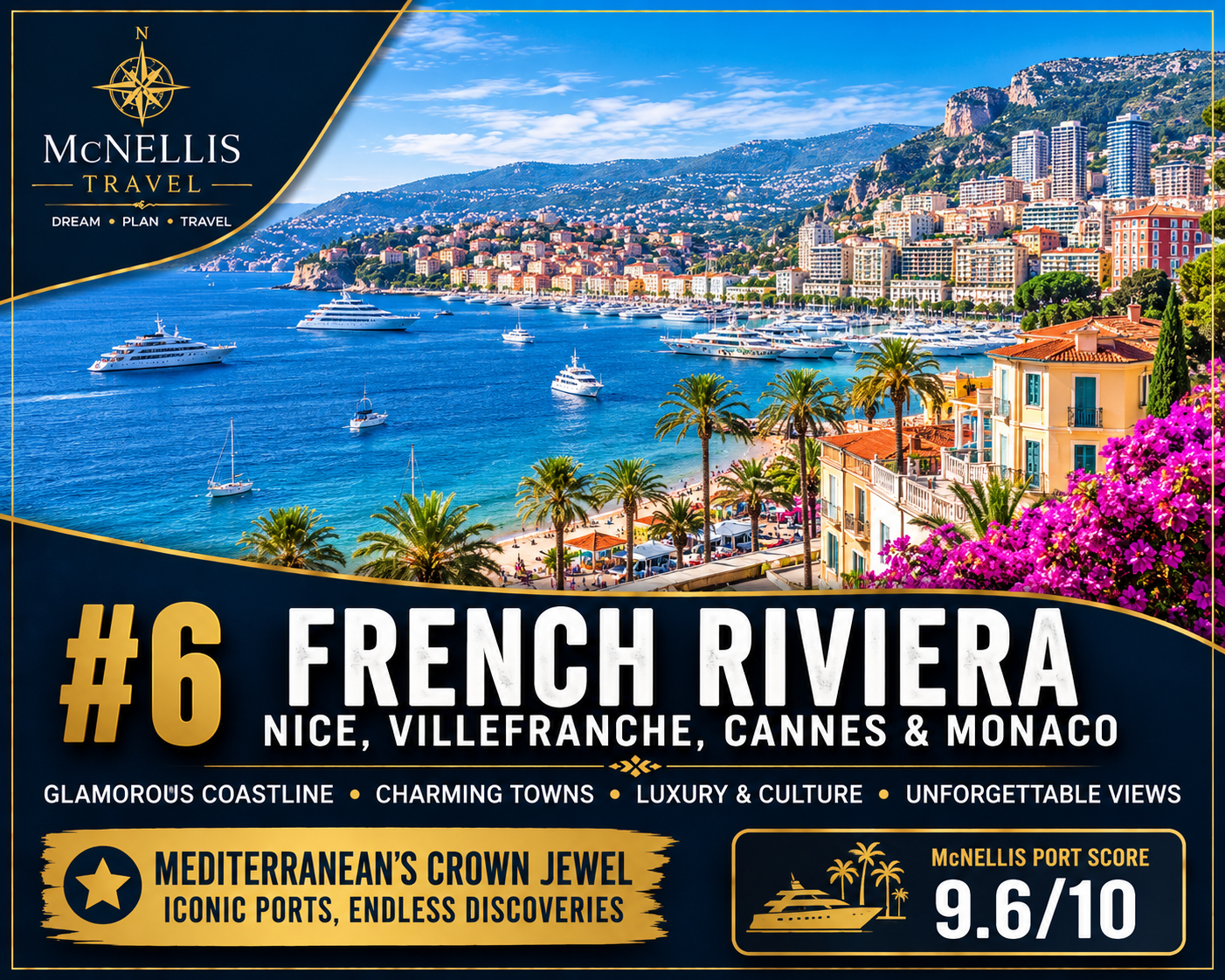
#6 French Riviera: Nice, Villefranche, Cannes & Monaco
What the French Riviera Is Really Like From a Cruise Ship
The French Riviera is unusual because the experience depends heavily on where the ship actually calls.
Villefranche-sur-Mer may involve tendering but places travelers beside one of the prettiest small harbors on the coast. Cannes offers immediate glamour and good rail connections. Nice is a substantial destination in its own right. Monaco may appear on some itineraries or become an excursion from another Riviera port.
Trying to visit Nice, Èze, Monaco and Cannes in a single day usually means experiencing the Riviera through a vehicle window.
Pick one or two.
Experience the Culture: The Riviera Is Not Just Wealth on Display
The Côte d'Azur is often marketed through yachts, casinos, luxury hotels and celebrity mythology. Those things exist, but reducing the region to wealth misses much of what makes southern France culturally interesting.
Nice, in particular, has a strong local identity shaped by its position between France and Italy. It became permanently French only in the nineteenth century, and the historic Niçois influence remains visible in food, architecture and language.
Walk through the Cours Saleya market area and pay attention to what is being sold. Olives, flowers, vegetables, cheeses and regional products connect the Riviera to Provence rather than to the luxury boutiques lining other streets.
Food provides a direct route into that identity.
Try socca, a thin chickpea pancake associated with Nice. Look for pissaladière, salade niçoise prepared in the local tradition, seafood and Provençal flavors built around olive oil, garlic, herbs and vegetables.
A café stop can also teach you something about French etiquette. Greet staff when entering. A simple bonjour before asking a question is expected courtesy, not decorative French. Likewise, merci and au revoir go a long way.
Do not interpret more reserved service as hostility. American expectations around restaurant interaction are not universal.
If visiting smaller villages such as Èze, remember that the beautiful stone lanes are not solely visitor attractions. People live and work there. Keep voices reasonable and respect private doors and residential areas.
The Riviera also has a substantial artistic legacy. Matisse, Chagall, Picasso and many other artists were drawn to the region's light and landscape. A museum or gallery can provide a deeper experience than adding another viewpoint to the day's checklist.
Monaco creates yet another cultural layer. It is an independent principality, not simply an expensive neighborhood of France. If you visit, understand that you have technically entered a separate sovereign state.
The best Riviera day combines beauty with enough unstructured time to notice why generations of people have wanted to live there.
Know Before You Go
France is currently Level 2: Exercise Increased Caution under U.S. State Department guidance because of terrorism and unrest. The State Department also notes pickpocketing and phone theft in crowded areas and the possibility of protests or strikes affecting transportation.
Rail travel between Riviera towns can be extremely useful, but do not build a return-to-ship plan with no time buffer.
McNellis Port Verdict
Best for: Couples, scenery, food, art and travelers comfortable exploring independently.
Potential drawback: Too many appealing destinations can lead to an overplanned day.
Would we choose an itinerary because the Riviera is included? Yes, particularly when the port allows straightforward independent exploration.
McNellis Port Score: 8.9/10
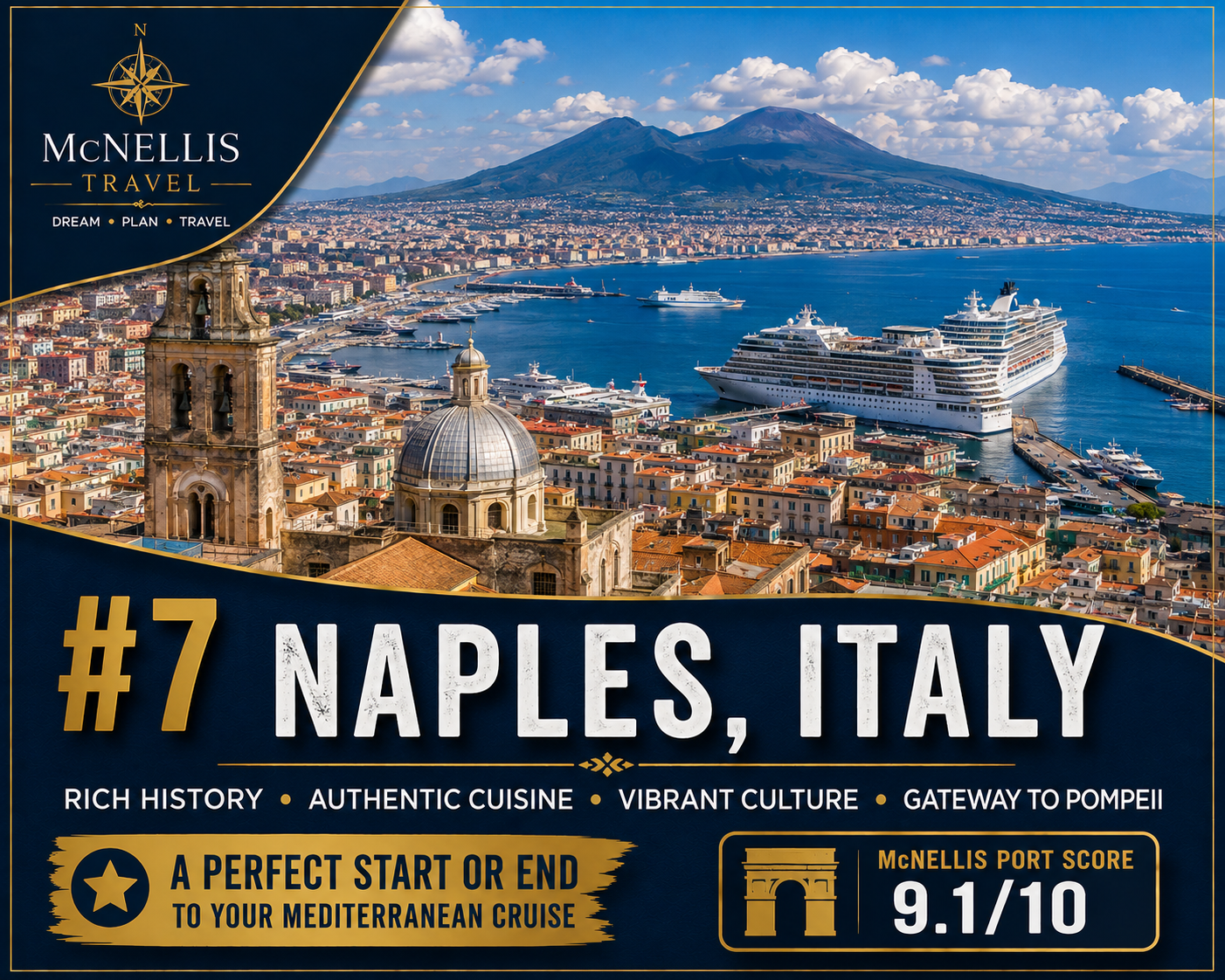
#7 Naples, Italy
What Naples Is Really Like From a Cruise Ship
Naples is one of the Mediterranean's most misunderstood cruise ports.
Some travelers step ashore expecting a polished Italian postcard and are immediately surprised by traffic, noise, graffiti and chaotic energy.
Others fall in love with it almost instantly.
The port is close to central Naples, which gives independent travelers enormous freedom. At the same time, Naples is the gateway to Pompeii, Herculaneum, Mount Vesuvius, Capri, Sorrento and the Amalfi Coast.
The problem is obvious: you cannot meaningfully do all of them in one port call.
Experience the Culture: Do Not Ask Naples to Behave Like Florence
Naples has a personality so strong that travelers tend to react to it.
The worst approach is expecting the city to behave like a polished museum district.
Naples is dense, loud, fast and intensely lived-in. Laundry hangs between buildings.
Scooters appear from seemingly impossible directions. Religious shrines occupy street corners. Bakeries, espresso bars, fish markets and tiny shops operate underneath apartment buildings where families have lived for generations.
This is part of the experience, not evidence that Naples has somehow failed to prepare itself for visitors.
Pizza matters here for reasons beyond lunch.
Naples is the birthplace of pizza as we know it, and traditional Neapolitan pizza remains deliberately simple: carefully made dough, tomatoes, cheese, olive oil and intense heat.
Eating one in Naples connects you to a food tradition that spread around the world.
Espresso culture is equally revealing. Coffee can be taken quickly while standing at the bar. You do not need to turn every coffee into an hour-long café stop.
Look for sfogliatella, babà, seafood, pasta and ingredients tied to Campania. If you are headed toward Pompeii or the Amalfi Coast, remember that those destinations also have their own identities; they are not simply extensions of Naples.
Religion is highly visible in Neapolitan culture, sometimes mixed with traditions and beliefs that may surprise visitors. Street shrines, saints, churches and devotion to figures such as San Gennaro remain part of local identity.
Naples also rewards a little humility.
Do not spend the entire visit comparing it unfavorably with Rome, Florence or Venice. Neapolitans know their city is different. That difference is the point.
Basic Italian greetings help. Start with buongiorno or buonasera. Say grazie. In markets or small shops, observe how locals interact before assuming every interaction should work exactly as it does at home.
Above all, keep your eyes open. Naples is not background scenery on the way to Pompeii. For travelers willing to engage with it, the city itself can be the port-day experience.
Know Before You Go
Italy is currently listed by the U.S. State Department at Level 2: Exercise Increased Caution due to terrorism.
For most cruise passengers in Naples, practical concerns are more immediate: busy traffic, petty theft, crowded transportation and keeping track of time when taking independent trains or ferries.
If you choose Capri or the Amalfi Coast, build considerable return-to-ship margin into the day. Ferries, road traffic and summer crowds can disrupt optimistic schedules.
McNellis Port Verdict
Best for: Food, archaeology, independent exploration and travelers who enjoy energetic cities.
Potential drawback: The intensity can overwhelm visitors expecting a relaxed or manicured destination.
Would we choose an itinerary because Naples is included? Yes. Few ports provide this many genuinely world-class choices.
McNellis Port Score: 8.8/10
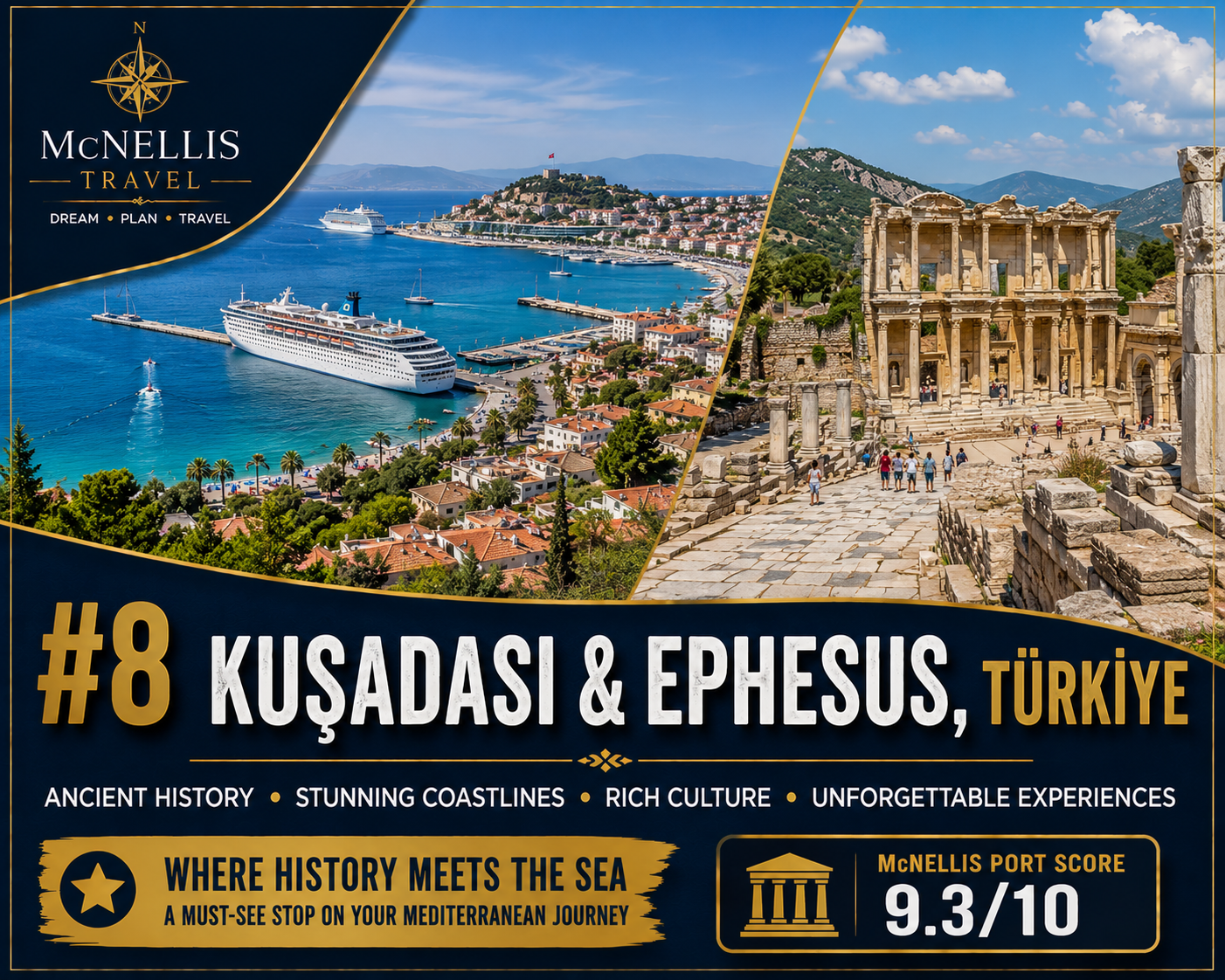
#8 Kuşadası & Ephesus, Türkiye
What Kuşadası Is Really Like From a Cruise Ship
Kuşadası itself is a pleasant Turkish coastal resort and port city, but the reason it ranks this highly is located inland.
Ephesus is exceptional.
The ancient city is one of the Mediterranean's most important archaeological experiences, with monumental streets, temples, public buildings and the extraordinary Library of Celsus creating a scale that photographs struggle to convey.
For many visitors, this is the day to use a knowledgeable guide. Understanding what you are seeing significantly improves Ephesus.
Experience the Culture: Do Not Treat Türkiye as a Ruins Excursion
It is easy to spend a Kuşadası port call moving from the ship to Ephesus and back without learning much about contemporary Turkish culture.
That would be a missed opportunity.
Begin with hospitality and food. Turkish tea is ubiquitous, and coffee carries its own traditions. If your schedule allows, try a meal or small selection of dishes rather than rushing directly back onto the ship after the archaeological site.
Meze can include vegetables, yogurt-based dishes, seafood and spreads. Pide, grilled meats and regional dishes provide far more variety than the simplified idea of “Turkish food” many visitors arrive with.
Markets and shops can involve a more conversational style of selling than Americans are accustomed to. You may be invited inside, offered tea or encouraged to examine carpets, leather, jewelry or other goods.
You are allowed to say no.
Do it politely.
Likewise, if you genuinely want to buy something, understand whether bargaining is appropriate before beginning. Negotiation can be social. It should not become insulting or adversarial.
Ephesus itself deserves cultural respect. Ancient stones are not playground equipment. Follow instructions about where visitors may walk or touch structures, particularly in fragile archaeological areas.
Nearby religious sites may also be important to Christian or Muslim visitors. The House of the Virgin Mary, for example, attracts pilgrims as well as tourists. Treat people engaged in religious devotion accordingly.
Turkish society is diverse. Coastal tourist areas can appear socially relaxed, while attitudes elsewhere may be more conservative. Visitors should avoid assuming that a resort district represents the entire country—or that political decisions represent every individual resident.
Dress expectations become more important when entering mosques or active religious sites. Follow posted rules without turning them into a debate about whether you agree with them.
One of the simplest ways to have a better experience is to ask your guide about modern life as well as ancient Ephesus. What do families eat? Where do Turkish travelers vacation? How has Kuşadası changed as cruise tourism expanded?
A great cultural experience begins when curiosity extends beyond the ruins.
Know Before You Go
The same Level 2 U.S. advisory for Türkiye discussed above applies here. Travelers should review the current official guidance before departure.
LGBTQ+ travelers should also be aware of the July 2026 cancellation involving the Atlantis Events charter. Kuşadası was specifically one of the scheduled Turkish ports that authorities prevented the sailing from visiting.
Again, travelers should distinguish between a government decision involving a highly visible charter cruise and the likely experience of every individual LGBTQ+ visitor. But omitting the incident from a 2026 guide would not serve travelers honestly.
McNellis Port Verdict
Best for: Archaeology, ancient history, guided cultural touring and first-time visitors to Türkiye.
Potential drawback: Travelers primarily interested in a beach or casual walk-off-the-ship day may find the main experience more excursion-driven.
Would we choose an itinerary because Kuşadası is included? Yes, particularly for travelers who have never visited Ephesus.
McNellis Port Score: 8.7/10
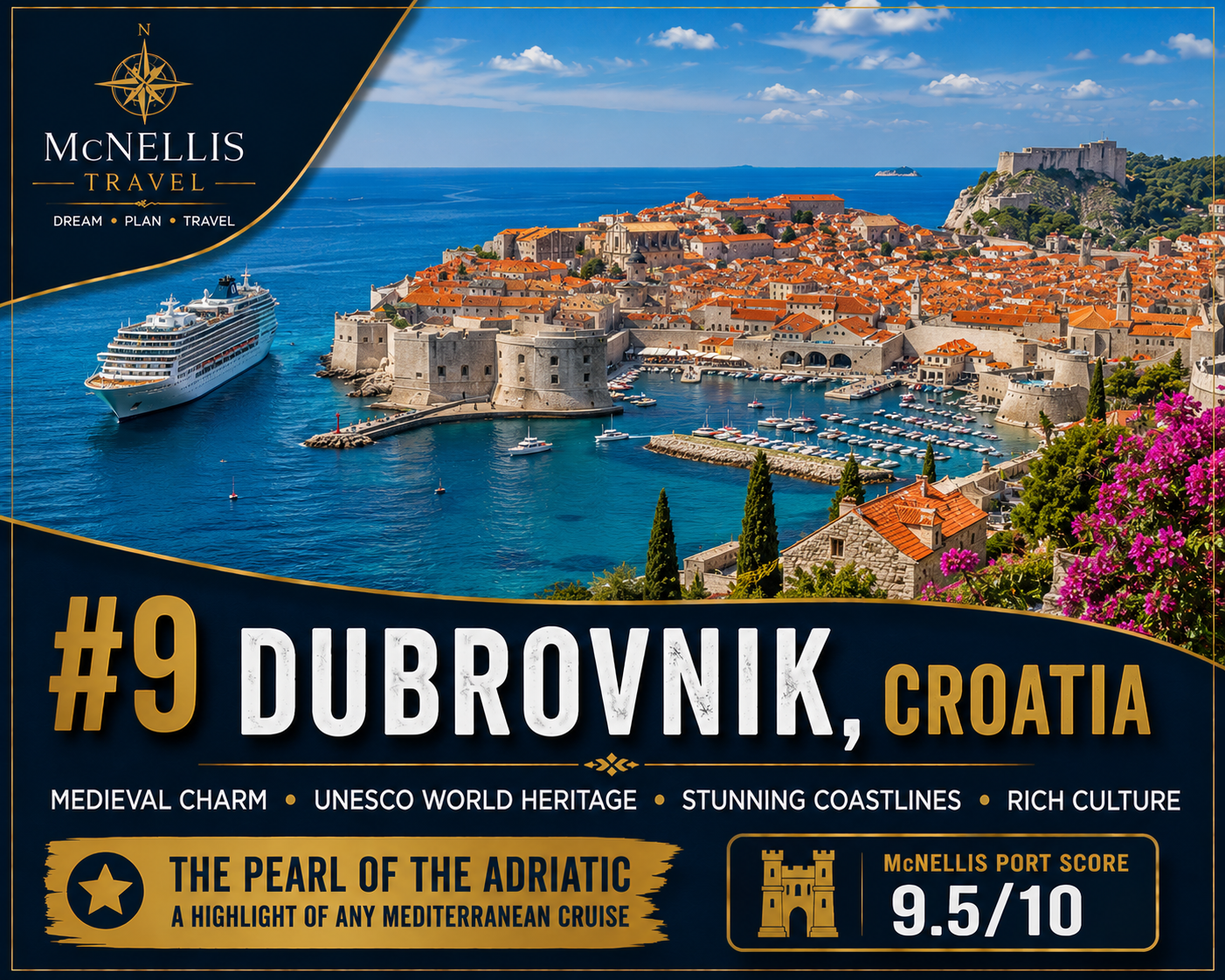
#9 Dubrovnik, Croatia
What Dubrovnik Is Really Like From a Cruise Ship
Dubrovnik delivers one of the Mediterranean's most dramatic first impressions.
Stone walls surround an old city pressed between mountain and sea, with terracotta roofs, polished streets and views across the Adriatic.
Most large cruise ships use the port at Gruž rather than docking directly outside the historic walls, but reaching the Old Town is relatively straightforward by shuttle, taxi or local transportation.
Once there, the experience becomes very walkable—with one important warning: stairs.
Experience the Culture: Dubrovnik Is a City Before It Is a Film Set
Dubrovnik's popularity has created an unusual problem.
Millions of people recognize its walls and streets before they know much about the people who actually live there.
The city's role as a filming location—especially for Game of Thrones—brought enormous international attention. Those tours can be fun, but Dubrovnik's history is far more interesting than its fictional identity.
For centuries, Dubrovnik was the center of the Republic of Ragusa, a maritime republic that used diplomacy, commerce and skilled negotiation to maintain a surprising degree of independence among much larger powers.
The city's motto is often translated as “Liberty is not sold for all the gold in the world.” That historical emphasis on independence still matters to understanding Dubrovnik.
More recent history matters too.
Dubrovnik was shelled during the Croatian War of Independence in the early 1990s.
Much of the Old Town has been carefully restored. When you look across those beautiful roofs from the walls, you are also looking at a city within living memory of war.
That context should encourage a little more respect than treating every staircase as a television backdrop.
Croatian food along the Dalmatian coast reflects the Adriatic. Look for seafood, grilled fish, octopus, shellfish, olive oil and regional wines. Meat dishes and Balkan influences become more noticeable as you explore beyond the immediate coast.
Coffee culture is also deeply social. Sitting with a coffee is not necessarily a quick caffeine transaction.
Within the Old Town, remember that residents still live behind some of those shutters and doors. Keep noise reasonable in residential lanes. Do not block doorways or photograph people inside their homes.
Basic Croatian courtesies such as dobar dan for good day and hvala for thank you can be appreciated, though English is widely spoken in tourism.
If time permits, step away from the main Stradun thoroughfare. Small side streets reveal a quieter Dubrovnik and make it easier to understand that this is a community squeezed inside an extraordinarily famous historic center.
Know Before You Go
The current U.S. State Department advisory for Croatia is Level 1: Exercise Normal Precautions, dated May 18, 2026. The State Department describes Croatia as generally safe for travelers.
Dubrovnik's more immediate challenges involve physical accessibility and crowds.
The city walls include many steps and exposed walking areas. Old Town streets can become extremely busy when several ships and land tours arrive simultaneously.
Travelers with mobility concerns should plan routes carefully rather than assuming the compact city is automatically easy.
McNellis Port Verdict
Best for: History, scenery, photography, independent walking and Adriatic itineraries.
Potential drawback: Crowding and extensive stairs.
Would we choose an itinerary because Dubrovnik is included? Yes. The city is compact enough to work exceptionally well within a cruise schedule and historically rich enough to reward travelers who look beyond the photographs.
McNellis Port Score: 8.6/10
Choosing Between the Top Mediterranean Cruise Ports
The first nine ports already demonstrate why choosing a Mediterranean itinerary by destination names alone can be misleading.
Barcelona offers a completely different port day from Santorini. Valletta rewards independent exploration, while Ephesus becomes more meaningful with interpretation.
Naples gives travelers an almost overwhelming number of excursion choices. Istanbul demands more cultural preparation but can deliver one of the deepest experiences of the entire cruise.
That difference is exactly why itinerary planning matters.
A Mediterranean cruise should not be chosen simply because it visits the largest number of famous places. Look at how the ship reaches each destination, how long it stays, whether the port is tendered, what transportation is required and how physically demanding your preferred experiences will be.
Travelers comparing specific routes can use McNellis Travel's expanded Mediterranean itinerary guide for a deeper look at Western, Eastern and Adriatic cruise patterns. Compare Mediterranean cruise itineraries
And remember that travel conditions can change after an article is published. U.S. travelers should review the Department of State's current destination guidance close to departure rather than relying exclusively on an advisory level quoted in any travel article. Check current U.S. State Department Travel Advisories
In Part 2, we continue the ranking with Rome/Civitavecchia, Livorno/Florence, Kotor, Palma de Mallorca, Mykonos, Split, Corfu, Messina/Taormina and Marseille—then compare which ports are best for history, food, scenery, independent exploration, first-time Mediterranean cruisers and travelers who want a less demanding port day.