MARGE’S TRAVEL INSIGHTS
Is a Swim-Out Room Worth It? How to Choose Your Room at an All-Inclusive Resort
Is a swim-out room worth it? Compare shared pools, private plunge pools, ocean views, and club-level perks before upgrading your all-inclusive stay.
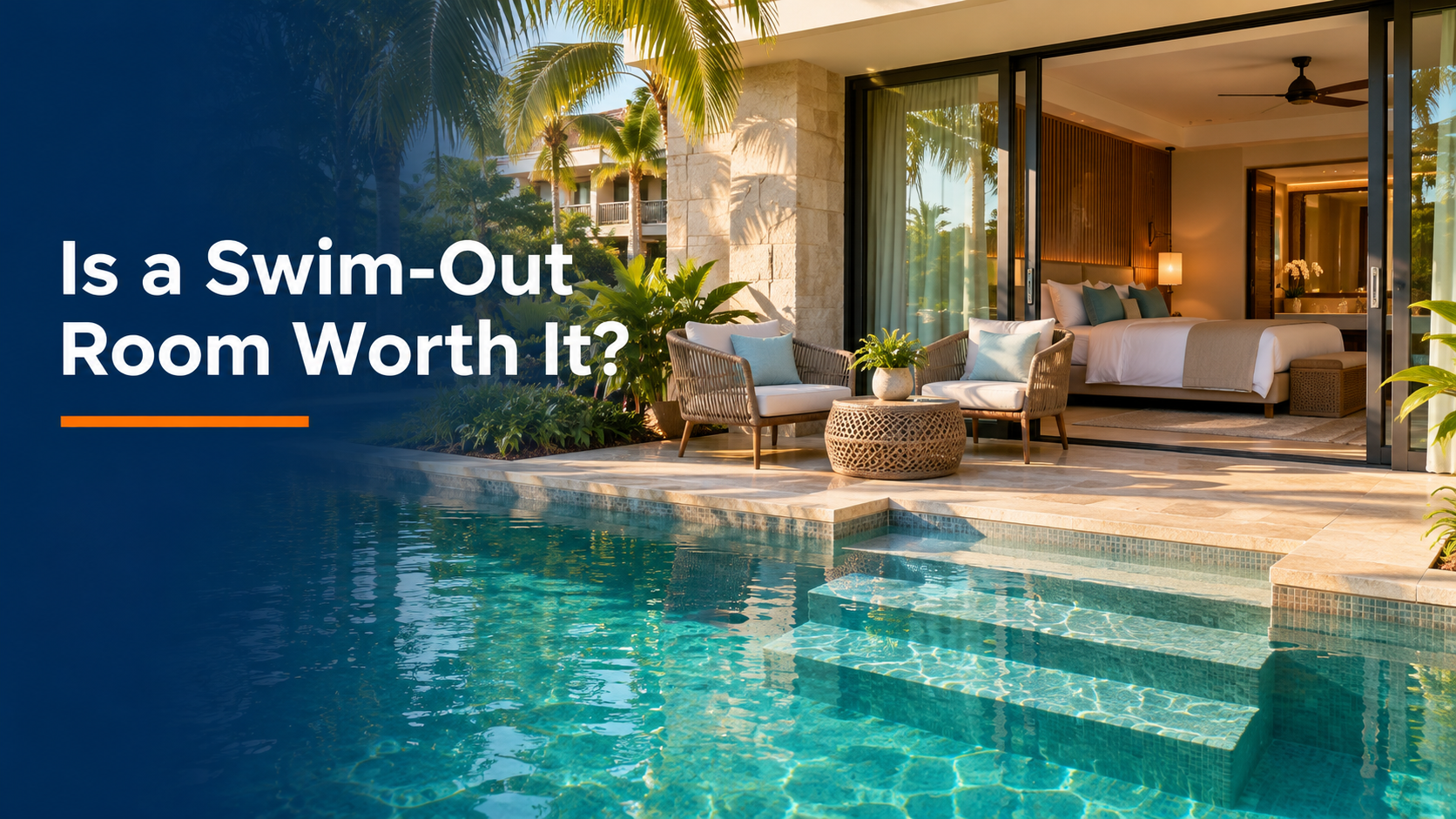
You’ve picked the resort. Now you’re looking at two rooms for the same dates. One has an upstairs balcony and an ocean view. The other opens straight onto a pool. The swim-out looks better in the photos, but you’re planning to spend most afternoons at the beach. Which one would you actually use?
Start by picturing an ordinary day on the trip, not the first five minutes after check-in. If you like to come back to the room for a quiet swim between lunch and dinner, direct pool access might be worth paying for. If your favourite part of a resort stay is coffee on the balcony while everyone else is still asleep, a better view might matter more.
The tricky part is knowing what the room name actually promises. A private terrace is not the same thing as a private pool. And even a pool nobody else can enter may be visible from nearby rooms or a walkway. These are separate features, and it’s worth checking each one before paying for the upgrade.
If you’re still deciding on the property itself, start with the Travel With McNellis all-inclusive resort guide. Once you have a resort in mind, compare the exact room categories available for your dates.

Swim-Out vs. Private Plunge Pool: What Are You Paying For?
A swim-out, sometimes called a swim-up, gives you direct access to a pool from your room’s patio or terrace. The water may connect several rooms. With a private plunge pool, the water is reserved for your room, but check the size: what looks like a pool you could swim laps in might be designed for sitting and cooling off. The useful distinction is direct access versus exclusive use.
The difference shows up clearly at Dreams Playa Mujeres. Its Preferred Club Master Suite Swim Out Ocean View lists a private furnished terrace and access to a semi-private pool. The resort lists a separate Ocean Front with Private Pool category. If you stop reading at “private furnished terrace,” you could book the first room expecting the second.
When a Swim-Out Is Worth It
A swim-out earns its keep when you’ll use the pool because it’s right outside. Think about a quick dip before breakfast or an afternoon back at the room when one person wants to read and the other wants to swim. You don’t need to spend the whole day on your terrace to get value from it. You do need to like the idea of spending some of your vacation there.
It’s less compelling if you’d normally choose the beach, the main pool, or a spot near the pool bar. And if the main reason you’re upgrading is privacy, ask whether other guests can swim past your terrace or walk beside it. A shared pool might still be exactly what you want. It just shouldn’t be a surprise.
When a Private Plunge Pool Is the Better Choice
A private plunge pool makes more sense when you want water you don’t have to share. Imagine a couple who likes a quiet hour back at the room before dinner. They might get more from a small pool of their own than from a larger one connecting several terraces.
But private use doesn’t mean private from view. Ask whether the terrace is overlooked by balconies, bordered by a path, or screened from neighbouring rooms. If you’re picturing a pool you can linger in, ask about its dimensions, depth, steps, and whether it’s heated. If shade or afternoon sun matters to you, ask about the exposure of that room category, not the resort grounds generally.
At a Family Resort, Check the Room’s Rules Separately
A family-friendly resort doesn’t necessarily offer every room category to children of every age. For example, Dreams Playa Mujeres lists its Preferred Club Master Suite Swim
Out Ocean View for guests age 13 and older. That’s a rule for that specific category, not a rule for all swim-outs. Confirm eligibility for every traveler before comparing prices.
If children are eligible, ask how the terrace door locks and whether there’s a barrier between the patio and the water. If anyone has mobility needs, ask for specifics about the route to the room and the steps or handrails at the pool. “Ground floor” tells you where the room is; it doesn’t tell you whether the whole setup works for your party. The McNellis guide to Dreams Resorts & Spas is a useful starting point for comparing family room options.
What to Ask Before You Book a Pool Room
Who can use the water? Only your room, neighbouring rooms, or a wider group of guests?
What’s outside the terrace? A screened patio, a walkway, another building, or a busy pool area?
When can you use it? Confirm hours and any rules for the exact pool.
What does the room give up? Compare the view, terrace space, and location with the non-swim-out room you’d book instead.
Can you see photos of the exact category? Ask whether the photos show a representative room and which features are guaranteed on the booking confirmation.
The deciding question: If the pool were closed for one afternoon, would you still like the room? If you’d be happy with the terrace, location, and view, the swim-out may be a good fit. If the room would suddenly feel like a downgrade, compare it carefully with the upstairs balcony before paying the difference.
Three golden questions: Is every claim supportable? Does this help the reader make a better decision? Is it polished and ready to go, or can I do better? The examples below use the resorts’ own room descriptions, and the comparison separates what you can see from where the room is and how you get to the beach.
Ocean View vs. Oceanfront: What Will You Actually See?
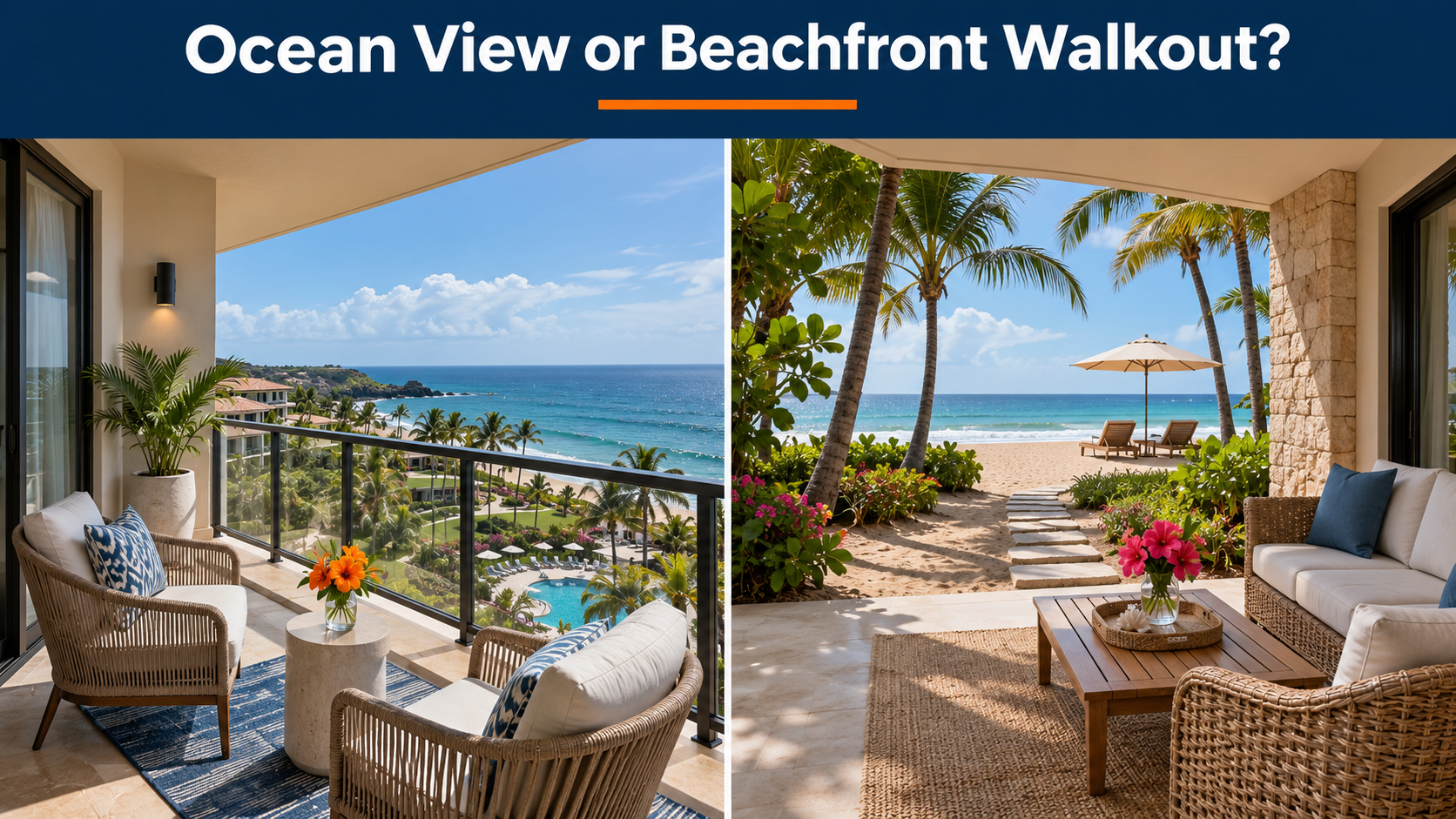
An ocean view, an oceanfront location, and direct beach access are three different things. You might want all three, but it helps to know which one you’d actually pay for.
If you’re picturing coffee on the balcony with the water straight ahead, ask what you can see while seated. If you want to go back and forth between the beach and your room without packing a bag every time, ask about the walking route. A higher-floor room farther back could give you the view you want, while a ground-floor walkout could make beach days easier. Those are different upgrades.
Room label
What to check before booking
Partial ocean view
How much water is visible, from where, and whether you have to stand or look to one side.
Ocean view
Whether the water is visible from the room, the balcony, or both, and what sits between you and the shoreline.
Oceanfront
Which building and side of the property the room is on, whether the view varies by floor, and how you reach the beach.
Beachfront walkout
What the patio opens onto, whether there are steps or a path, and how much foot traffic passes the terrace.
Treat these as questions to ask, not definitions every property follows. Secrets Akumal Riviera Maya lists its Junior Suite Partial Ocean View separately from its Tropical View category. Sandals Negril goes further for its Paradise Beachfront Walkout Club Level Room: it specifies the building, first-floor location, and walkout patio. That level of detail is much more useful than a photo of the resort’s beach.
Decide Whether You’re Paying for the View or the Location
Say you’re comparing an upper-floor ocean-view room with a ground-floor beachfront walkout. If your holiday starts with a quiet hour on the balcony, the upper-floor room might be the better buy. If you expect to spend the day on the sand and make several trips back for a book, sunscreen, or a change of clothes, the walkout might save more time than the balcony adds enjoyment.
Look at a property map and trace the route from the room’s building to the places you’ll use most: the beach, breakfast, the main pool, and wherever you expect to spend your evenings. Ask about steps, elevator access, and slopes if those matter to your group. If you’re a light sleeper, check what’s beside or below the room. A shorter walk to the action isn’t necessarily an upgrade if you want to turn in early.
And if someone in your group wants to swim in the ocean, don’t treat a shoreline view as an answer to that question. Ask about the beach the room serves, where guests enter the water, and what the resort says about swimming conditions. An oceanfront room can be worth it for the view alone; just be clear about what you’re buying.
Look at Photos of the Room Category, Not the Resort Gallery
A sweeping photo taken from the rooftop tells you what the view is like from the rooftop. It doesn’t tell you what you’ll see from your balcony.
Ask for photos of the exact room category and whether they show a representative room or one particular unit. Look at the direction the chairs face, what’s below the balcony, and whether palms, roofs, or other buildings sit in the sightline. If the view is the reason you’re upgrading, ask the resort or your travel advisor:
If I book this exact category, what view is included? Does it vary by floor or building, and is a higher floor guaranteed or only a request?
Separate the answer into what you’re booking and what you’re asking for. If the reservation includes an ocean view but a high floor is only a preference, decide whether you’d still pay the premium for a lower-floor room in that category. That’s the room you need to be happy with—not just the one in the best photo.
When It Makes Sense to Skip the View Upgrade
If you expect to be out most of the day, a quieter garden-view room in the right building might do more for your vacation than a balcony you rarely use. On the other hand, if you know you’ll spend time on that balcony every morning and evening, the upgrade can be part of the experience rather than just a nicer backdrop.
For property-specific details, the McNellis guide to Secrets Resorts & Spas is a useful starting point. Then compare the written descriptions and total prices for your dates. If the only difference you can name is the word oceanfront, you don’t yet know enough to pay more for it.
Three golden questions: Is every claim supportable? Does this help the reader make a better decision? Is it polished and ready to go, or can I do better? This section compares club-level perks with what’s already included, using examples from the resorts’ own descriptions.

Is Club Level Worth It at an All-Inclusive Resort?
Club level is worth considering when it adds something you’ll use that your standard room doesn’t already include. That might be a breakfast spot you’d gladly start every morning in, a quieter place to spend the afternoon, or a room location that saves you a long walk back from the beach.
The mistake is counting every item in the club brochure as an upgrade. If your standard room already includes room service and a stocked minibar, the question is what the club version does differently—not whether those services exist.
Compare the Club Room With the Standard Room You’d Actually Book
Start with two quotes for the same stay. Put the exact room names side by side and separate the differences into the room itself and the services or spaces you gain access to.
At Secrets Akumal Riviera Maya, for example, the resort lists 24-hour room service and a daily refreshed minibar among its general room amenities. Its Preferred Club separately lists an upgraded minibar, a club lounge with continental breakfast, and suites in preferred locations. So if you’re booking mainly to order breakfast to your room, look at what the standard category already gives you. If you’re booking for the lounge or the location, compare those on their own merits.
There’s another distinction worth making: a room feature you’ll enjoy doesn’t automatically make the club perks valuable. If the club suite also has the ocean view you want, ask whether a non-club ocean-view room is available. If it is, you have a better way to judge how much you’re paying for the view and how much you’re paying for everything else.
Ask What “Exclusive Access” Gets You on an Ordinary Day
A lounge can be a real perk if it’s close to your room and open when you’d use it. It’s less useful if you’d rather have a full breakfast at the main restaurant and spend the rest of the day outside. The same goes for a designated pool or beach area: ask where it is and whether it’s the part of the property you’d choose anyway.
Before paying for access, get specific:
Breakfast or dining: Is it a full restaurant, a lighter lounge breakfast, or priority booking at a venue other guests can also use?
Pool or beach: Is there a separate area, or are you getting access to a designated section of a shared space? Where is it relative to your room?
Check-in and checkout: Does the upgrade offer a separate desk, or does it actually change when you can get into or keep your room?
Traveling together: If friends or relatives book standard rooms, can they join you in the club spaces? If not, will you use those spaces enough to justify the cost?
That last question can settle the decision. There’s little point in paying for a separate breakfast venue if the best part of the trip is meeting everyone for breakfast downstairs.
Concierge and Butler Service Aren’t the Same Upgrade
Ask what someone will do for you, not just what the service is called. Club Sandals lists concierge help with restaurant, spa, and tour reservations. Its separate Butler Elite service lists more personalized tasks, such as in-suite check-in and arranging a private dinner served in your suite or on your patio. Booking assistance also doesn’t make a spa treatment, tour, or private dinner free; confirm the price of the activity itself.
If you’re celebrating and want someone to help coordinate several details, personal service may be part of what makes the trip feel special. If you usually choose dinner on the day and rarely ask for help with arrangements, a better-located room may matter more. If Sandals is on your shortlist, compare the room and service options through the McNellis resort guide, then check the written inclusions for your exact category.
The Two-Perk Test
Before you upgrade, name two perks you expect to use and say when you’d use them. “We’ll have breakfast there on most mornings, and we’ll spend our afternoons at the club pool” is a clearer reason than “It sounds more exclusive.” One perk can be enough if it genuinely matters to you, but name it and compare the full-stay price difference.
If what you really want is an ocean view, a quiet building, or a terrace with shade, price that feature first. You may get the room you want without paying for a tier you won’t use.

What Does the Room Upgrade Cost for the Whole Stay?
An extra $60 a night sounds manageable. But is that per room or per person? For two adults staying five nights, the difference is $300 if it’s per room and $600 if it’s per person. Before you decide whether the swim-out is worth it, get both quotes on the same basis.
A Five-Night Example: Where Would You Spend the Extra $600?
Imagine two adults comparing three room categories at the same all-inclusive resort.
These are hypothetical totals for both travelers, including taxes and mandatory fees. The dates, meal plan, and cancellation terms are the same, and flights and transfers aren’t included in any of the quotes.
Room category
Five-night total for two
Extra vs. the standard room
Standard garden-view room
$2,400
—
Upper-floor ocean-view room
$2,700
$300
Swim-out room with shared pool access
$3,000
$600
If you’re already willing to pay for the ocean view, the swim-out is $300 more than the room you’d otherwise book, not $600 more. But you’re also trading the upstairs balcony for ground-floor pool access. The higher-priced room isn’t simply the same room with a pool added.
Now put the difference next to something else you’d genuinely enjoy. Would you rather spend $300 more on the swim-out or keep the ocean view and put that money toward a better flight, a private transfer, or an excursion? If you know you’ll use the swim-out every afternoon, it might win. If you’ll be off the property for two full days and spend the rest of your time on the beach, the ocean view or the standard room might make more sense.
Make Sure the Quotes Match Before You Compare Them
If one quote is for the room only and the other includes flights or transfers, you can’t tell how much the room upgrade costs just by subtracting the totals. Ask for both room categories within the same package, or ask your advisor to show you what else changed.
Check that both quotes cover the same:
Dates and travelers: Same number of nights, guests, and ages at the time of travel.
Price basis: Same currency, with the full cost for everyone and any mandatory charges still due at the resort shown separately.
Package inclusions: Same flights, baggage allowances, transfers, and meal plan, or a clear explanation of what differs.
Booking terms: Same deposit, payment deadline, and cancellation or change terms, or a clear explanation of what you’d give up.
A $300 upgrade with the same cancellation terms is one decision. A $300 upgrade that also makes more of your booking non-refundable is another. If your dates aren’t firm, flexibility may be worth more to you than the room feature.
A Quick Checklist Before You Book
Ask the resort or your travel advisor to confirm the details that would change your decision:
What exact room category is on the quote? Get the full name or category code, and ask for photos of that category.
What’s guaranteed, and what’s only requested? Confirm the view, bedding, and any floor or building location you’re counting on.
Who can use the pool? For a swim-out, ask who shares the water. For a private pool, ask about screening, shade, and whether the setup works for everyone traveling.
What does club level add to this booking? Name the perks you’ll actually use and confirm each traveler’s access.
What’s the price difference for the whole stay? Compare it with the room you’d otherwise choose, then with what else that money could buy.
Would you still like the room if you used the upgrade less than planned? Think about the location, noise, view, and outdoor space. You’re booking the entire room, not just its best feature.
So, Is a Swim-Out Room Worth It?
Yes, if you’ll use the pool because it’s right outside and you’re happy with what you’re getting in exchange. If you care most about having the water to yourself, price a private plunge pool instead. If your favourite resort moment is coffee on an upstairs balcony, put your money toward the view. And if you mainly use the room to sleep and shower, there’s nothing wrong with booking the standard category in a location that works for you.

If you’re down to two or three rooms, ask Travel With McNellis to compare your resort options. Send Margen the resort name, your dates, and the room categories you’re looking at. Tell her what would make you glad you upgraded—a quiet terrace, a clear ocean view, or a pool you’ll actually use. That’s a better starting point than asking which room looks most luxurious.