MARGE’S TRAVEL INSIGHTS
Traveling With Kids: A Practical Family Vacation Guide for Parents
Traveling with kids? Compare family resorts and cruises, plan airline seating, pack smarter, and enjoy a smoother family vacation with Travel With McNellis.

Family vacations have a wonderful way of creating memories that stay with us long after the suitcases are unpacked. There are first airplane rides, discoveries on unfamiliar beaches, exciting adventures, and the simple pleasure of spending time together without the usual demands of everyday life. Sometimes, the moments children remember most aren't the expensive excursions but the little discoveries along the way.
Of course, traveling with children can also be challenging. A flight delay feels much longer with a tired toddler, a beautiful resort loses some of its appeal when the room doesn't accommodate your family comfortably, and an itinerary that looks perfect on paper can quickly become exhausting when everyone has different needs.
The difference between a frustrating vacation and an enjoyable one often comes down to decisions made long before departure. Choosing the right destination, understanding airline seating arrangements, selecting appropriate accommodations, and building enough flexibility into your plans can make an enormous difference.
Traveling with kids doesn't require planning every minute. It requires planning the things that matter so your family has more freedom to enjoy the experience.
Whether you're considering a Caribbean all-inclusive resort, a family cruise, or an international adventure, this guide will help you make practical decisions that lead to a more comfortable, enjoyable family vacation.
1. Choose a Family Vacation That Fits Your Children's Ages
One of the biggest mistakes parents make when planning a family vacation is choosing a destination based entirely on how appealing it looks to adults. A beautiful resort, exciting city, or ambitious sightseeing itinerary may sound wonderful, but the experience can feel very different when you're traveling with a two-year-old or an energetic seven-year-old.
The ages of your children influence almost every part of a successful vacation, from flight schedules and transportation to accommodations, activities, and mealtimes.
Instead of beginning with a list of popular destinations, start by considering what your family can realistically enjoy together.
Traveling With Babies and Toddlers
For families with babies and toddlers, convenience can be more valuable than an impressive list of attractions. A resort located close to the airport, comfortable accommodations with a refrigerator, and easy access to meals may contribute more to an enjoyable vacation than dozens of scheduled activities.
Consider how long it will take to reach your accommodations after landing. A four-hour flight followed by a lengthy immigration process and a two-hour transfer can be exhausting for a small child. Parents may find that spending a little more for a direct flight or a better-located resort is worth considerably more than a room upgrade.
Separate sleeping areas, access to laundry, shaded outdoor spaces, and appropriate childcare facilities also deserve attention. If your toddler still naps during the afternoon, having somewhere comfortable for one parent to relax while the child sleeps can make a significant difference.
Traveling With Elementary School Children
School-age children often enjoy a wider variety of activities, making this an exciting stage for family travel. Waterparks, wildlife encounters, snorkeling excursions, interactive museums, and beginner-friendly adventure activities can turn a vacation into something genuinely memorable.
However, the availability of activities doesn't automatically mean they're appropriate for every child. Age restrictions, height requirements, swimming abilities, and the physical demands of excursions should be checked before booking. A resort advertising an impressive waterpark may have several attractions your younger children cannot yet use.
Children in this age group also appreciate having a little influence over the vacation.
Allowing each child to choose an excursion, restaurant, or family activity can build excitement and help them feel included in the experience.
Families traveling with older children may benefit from our separate guide, Traveling With Teens: Destinations They'll Actually Love, which explores destinations suited to teenagers' growing independence and interests.

2. Compare Family Resorts, Cruises, and Vacation Packages Carefully
Not every family enjoys the same type of vacation. Some parents want the simplicity of an all-inclusive resort where meals, activities, and entertainment are close at hand.
Others prefer cruises that introduce their children to several destinations, while some families enjoy exploring cities or renting accommodations with more independence.
The important question isn't which vacation style is universally best. It's which one provides the right balance of convenience, enjoyment, flexibility, and value for your particular family.
All-Inclusive Resorts: Convenience Matters
A family-friendly all-inclusive resort can simplify vacation planning because accommodations, standard meals, and many recreational activities are generally included in the package. This can be especially appealing to parents who don't want to repeatedly calculate the cost of every meal, snack, and activity.
Nevertheless, all-inclusive resorts vary considerably. Some specialize in lively entertainment and extensive children's facilities, while others offer quieter surroundings and fewer organized activities. Children's clubs may have minimum ages, limited operating hours, or additional requirements, and certain experiences may cost extra.
For example, Beaches Resorts offers family-oriented Caribbean vacations with children's programming, waterparks, and a variety of accommodation options. The most suitable property and room category still depend on your children's ages, your budget, and the activities your family expects to enjoy.
Before choosing any resort, look beyond the promotional photographs. Consider the size of the property, walking distances, beach conditions, children's facilities, available dining options, and whether the resort's overall atmosphere matches your family's preferences.
Family Cruises: Several Destinations Without Repeated Packing
Cruises can provide an appealing alternative because families can visit multiple destinations while keeping the same accommodations throughout the voyage. Meals, entertainment, pools, and children's programming are often available onboard, reducing the need to organize every activity independently.
However, cruise ships differ considerably in size, amenities, children's facilities, and atmosphere. Families should compare stateroom configurations, childcare age requirements, port schedules, dining arrangements, and the additional cost of excursions or onboard purchases.
A family with younger children may prefer a ship offering splash areas, shorter excursions, and convenient dining. Parents with older children might prioritize waterslides, sports facilities, or more adventurous ports.
When exploring cruise vacations, remember that the ship is only part of the experience. The itinerary, port transportation, and time available ashore should also work for your family.

3. Flying With Children: Plan Your Seats Before You Board
Air travel is often one of the most stressful parts of a family vacation, particularly when parents are flying with younger children. Airports are busy, boarding can feel rushed, and unexpected delays can disrupt even the most carefully organized plans.
While parents cannot control every part of the flying experience, several important decisions can be made before departure. One of the most overlooked is where everyone will sit.
Why Family Seating Has Become Such a Controversial Issue
Airplane seat-swapping disagreements regularly generate heated conversations on social media. One passenger has reserved an aisle seat, perhaps paying extra for it, while another traveler asks that person to move so family members or a couple can sit together.
Some passengers are happy to accommodate the request. Others decline because they deliberately selected their seats, need additional comfort, or simply prefer to keep the arrangements they purchased.
Both the request and the response should be handled respectfully. Asking someone to exchange seats does not automatically mean that person is obligated to agree.
For families with young children, however, the situation raises important safety and supervision concerns. Parents understandably want to sit beside their children, particularly when those children are too young to manage independently during a flight.
That is why seating arrangements should be addressed during the booking process, rather than becoming an uncomfortable discussion after everyone has boarded.
Book Seats Together Whenever Possible
When selecting flights, review the airline's seating policy before purchasing your tickets. Some fares include advance seat selection, while others restrict your choices or charge additional fees for certain seating arrangements.
Whenever possible, book all family members on the same reservation and verify where each person will be seated. Don't assume that purchasing tickets together automatically guarantees adjacent seats, especially when booking through different reservations or combining connecting flights.
For example, parents traveling with two young children may prefer a row of three seats with the fourth family member immediately across the aisle or in the row ahead. The ideal arrangement depends on the aircraft's configuration, the children's ages, and which adult needs to sit beside each child.
Check your assignments again before departure. An airline schedule change, aircraft substitution, or rebooking can alter previously confirmed seats.
Understand Family-Seating Policies and Your Rights
Family-seating policies are not identical across every airline or country.
In the United States, the Department of Transportation maintains an Airline Family Seating Dashboard, identifying airlines that commit to seating children aged 13 and younger beside an accompanying adult without an additional fee, subject to specified conditions. Not every airline offers the same commitment.
For flights within, to, or from Canada, applicable regulations require airlines to take steps to seat children under 14 near their accompanying parent or guardian without an additional charge for those arrangements. The required proximity depends on the child's age: children under five should be adjacent to the accompanying adult, children aged five to eleven should be in the same row within one seat, and children aged twelve or thirteen should be no more than one row away.
These protections do not necessarily guarantee that every member of a larger family will sit together or that parents can select any preferred seats free of charge. The Canadian Transportation Agency's family-seating guidance explains the airline's responsibilities and the steps it should take when arrangements cannot be made in advance.
Before paying extra for family seating, find out what your airline already provides and whether your children's ages qualify for specific protections.
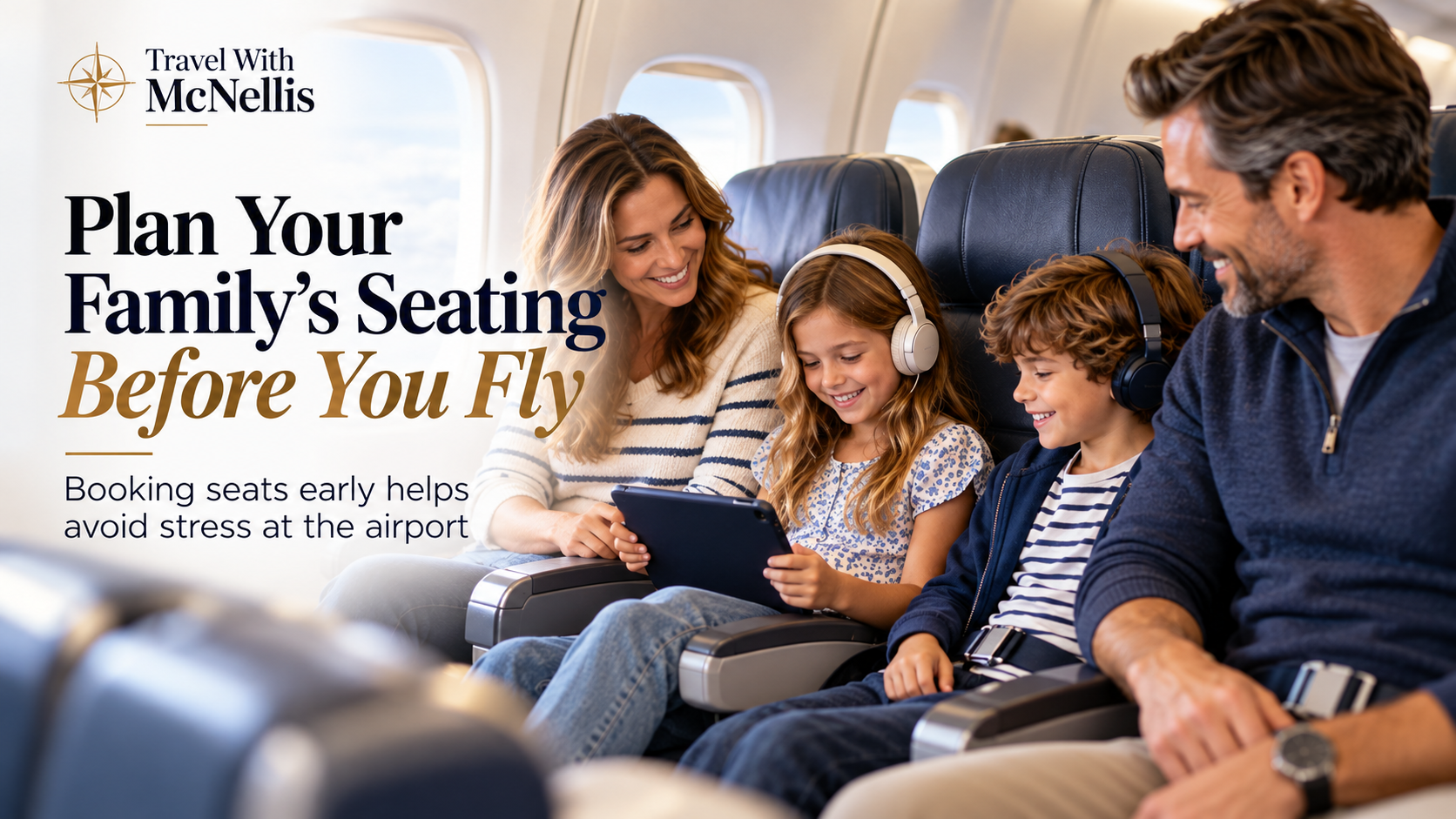
What Happens When Your Family Is Separated?
Even careful planning cannot prevent every seating problem. Flights are sometimes changed, canceled, or rebooked, and a family that originally had seats together may suddenly discover that its assignments have changed.
If this happens, contact the airline as soon as possible. Explain your children's ages, identify the passengers who need to sit together, and ask what arrangements can be made before departure. If the problem remains unresolved, speak with the gate agent before boarding.
The Canadian Transportation Agency's guidance describes a process in which airlines seek volunteers when appropriate seating cannot otherwise be arranged. It also advises that airlines should not force another passenger to change seats merely to place a child beside an accompanying adult.
Flight crews also have legitimate operational and safety responsibilities, and passengers must comply with applicable safety instructions. That is different from assuming that a traveler must surrender a carefully selected seat simply because another passenger would prefer it.
The most sensible approach is to remain courteous, explain the problem clearly, and allow airline staff to address the situation.
Couples Should Plan Their Seating Too
Although family seating is particularly important when young children are involved, the same planning principle applies to couples traveling together.
If sitting beside your spouse or partner matters to you, arrange those seats when booking whenever possible. Another traveler may have paid for a particular seat, selected it for a personal reason, or simply prefer not to move.
There's nothing wrong with politely asking whether someone would consider switching seats. But a refusal should be accepted respectfully, without arguments, insults, or attempts to embarrass the other passenger.
A peaceful flight begins with preparation, reasonable expectations, and consideration for everyone sharing the aircraft.
Make the Rest of the Flight Easier
Once seating arrangements are settled, turn your attention to the practical details that keep children comfortable. Choose connection times that allow for bathroom breaks, snacks, and unexpected delays. Keep essential medications, spare clothes, wipes, and children's entertainment in your carry-on rather than checked baggage.
Download movies or games before leaving home, and pack headphones that fit your child comfortably. For younger children, familiar books or a small favorite toy can provide reassurance in an unfamiliar environment.
If traveling with an infant or toddler, check the airline's policy on child restraint systems and approved car seats. A separate purchased seat with an appropriately approved child restraint can provide additional protection for a young child.
4. Choose Accommodations That Work for Real Family Life
A resort room may look beautiful online but still be impractical for a family sharing the space for an entire week. Parents should evaluate accommodations according to how the room will actually function, not simply its appearance or advertised maximum occupancy.
Consider where everyone will sleep, whether there is enough room for luggage, and what happens after younger children go to bed. A single hotel room with two beds may suit some families perfectly, while others will benefit considerably from connecting rooms or a suite with a separate sleeping area.
Bathroom access can also become surprisingly important. Four people sharing one bathroom may be manageable for a short stay, but additional facilities can make mornings and evenings much easier. Families traveling with babies may also appreciate a refrigerator, microwave access, or space to prepare bottles and simple meals.
When comparing all-inclusive resorts and vacation packages, verify the actual bedding configuration, children's occupancy rules, crib availability, and whether connecting rooms can be confirmed rather than merely requested.
Location within the property matters as well. Being near the pool or children's activities is convenient, but a room directly beside evening entertainment may be less appealing when your toddler normally goes to sleep at 7:30 p.m.

5. Organize Travel Documents Before the Last Minute
Travel documents should be reviewed early in the planning process, particularly when traveling internationally. Parents sometimes assume that young children have simpler requirements than adults, but infants and children generally need their own passports for international air travel.
Check every passport's expiration date and the entry requirements for your intended destination. Some countries require additional passport validity beyond the planned stay, while others have visa, authorization, or documentation requirements that vary according to nationality.
Families traveling with only one parent, with grandparents, or with another accompanying adult should also investigate whether parental consent documentation is required. Depending on the destination and circumstances, a signed or notarized consent letter or proof of legal custody may be necessary.
The U.S. Department of State's guidance on traveling with minors explains why destination-specific requirements matter and what parents should investigate before departure.
Don't forget to check whether your family needs travel insurance that covers medical treatment, interruptions, or other unexpected problems. Review policy exclusions, existing medical conditions, and coverage limitations carefully rather than assuming every policy provides identical protection.

6. Pack for Convenience, Not Every Possible Scenario
Packing for children can quickly become overwhelming, especially when parents begin preparing for every imaginable problem. The goal is not to bring everything your family owns. It is to make sure the essentials are available when you need them.
Start with the activities you have planned and the facilities available at your destination.
A resort with laundry services may allow you to pack considerably less clothing, while a vacation involving hiking or multiple climates may require more specialized items.
For your carry-on, prioritize the things you would genuinely need if your checked luggage were delayed or your flight took longer than expected:
Essential medications, necessary medical supplies, and copies of important information.
A change of clothes for younger children and a spare shirt for a parent.
Familiar snacks, empty refillable water bottles, and age-appropriate feeding supplies.
Wipes, diapers when needed, and small bags for soiled clothing.
Downloaded entertainment, headphones, and a favorite comfort item.
Chargers and other essentials that should remain accessible during the journey.
Parents should also check airline baggage restrictions and airport security rules for baby food, formula, liquids, strollers, and car seats. Policies can vary by country and airline, so confirming them in advance avoids unnecessary surprises.
One final suggestion: let children help pack an age-appropriate personal bag. Giving them responsibility for a few favorite items can make them feel involved, provided parents check the contents before leaving home.
7. Build a Family Schedule That Leaves Room to Breathe
It's tempting to fill every vacation day with activities, especially when you've spent considerable money getting everyone to a beautiful destination. But a schedule that looks exciting to adults can quickly become exhausting for children.
Young children still need food, sleep, downtime, and opportunities to play without rushing toward the next reservation. A morning excursion followed by lunch and an afternoon at the pool may create better memories than attempting to squeeze four attractions into one day.
Consider alternating active days with quieter ones. After a long excursion, a relaxed beach morning or casual afternoon exploring the resort may be exactly what your family needs.
Maintaining a few familiar routines can also help younger children adjust to unfamiliar surroundings. Bedtime rituals, favorite stories, and reasonably consistent meal schedules can provide comfort even when everything else feels new.
That doesn't mean recreating your entire home routine while on vacation. Staying up a little later for a special evening or changing plans for an unexpected opportunity can be part of the fun. The goal is to recognize when flexibility improves the experience and when everyone would benefit from some rest.

8. Understand the Real Cost of a Family Vacation
A vacation advertised at an attractive price isn't necessarily the least expensive option once all the details are considered. Families should calculate the likely total cost rather than focusing only on the advertised hotel or package rate.
Airline baggage charges, advance seating fees, airport transfers, excursions, meals outside a package, travel insurance, resort fees, and gratuities can add significantly to the final amount. Children may also be charged differently depending on their ages, room occupancy rules, and the supplier's pricing structure.
For example, a family of four might find an inexpensive flight appealing until they discover that checked bags and preferred seating cost extra. Another resort may have a higher nightly rate but include airport transportation and meals that would otherwise be purchased separately.
This is where comparing the complete vacation experience becomes more useful than simply finding the lowest advertised price.
Set a realistic budget before booking and decide which features matter most. If the children are likely to spend much of the vacation enjoying the pool and beach, a luxurious room upgrade may be less valuable than a better flight schedule or a family-friendly property.
Leave room for unexpected expenses, too. A little financial flexibility can prevent a minor inconvenience from becoming a major source of stress.
9. Common Family Vacation Mistakes Worth Avoiding
Many disappointing travel experiences begin with reasonable decisions that weren't examined closely enough. Parents may book a resort because it advertises children's facilities without checking age requirements, choose a tight airport connection to save money, or assume adjoining rooms will be available because they requested them.
Other problems arise when families try to accomplish too much. Booking a major excursion immediately after an overnight flight may not leave enough time for children to recover, while scheduling every afternoon can eliminate the flexibility needed when plans change.
One of the most useful habits is to identify the arrangements that could cause the greatest disruption if they go wrong. Seating assignments, accommodations, travel documents, transportation, and essential reservations deserve early attention because they can be difficult to resolve at the last minute.
Families should also resist the temptation to compare their vacation with carefully edited social media photographs. Real family travel includes occasional frustrations, unexpected changes, and children who sometimes have very different ideas about what constitutes a perfect afternoon.
A successful vacation isn't one in which nothing goes wrong. It's one in which the family has enough preparation and flexibility to keep enjoying the experience when something unexpected happens.
10. Frequently Asked Questions About Traveling With Kids
What Is the Best Age to Start Traveling With Children?
There is no single ideal age for a first family vacation. Babies, toddlers, and school-age children can all enjoy traveling, but the experience should be planned around their developmental needs, comfort, and the demands of the destination.
Younger children generally benefit from simpler itineraries and convenient accommodations, while older children may enjoy longer excursions and more adventurous activities. For infants, discuss any health or medical concerns with your pediatrician and confirm the airline's minimum-age requirements.
Do Airlines Have to Seat Parents Beside Their Children?
The answer depends on the airline, the route, the child's age, and the applicable regulations. Certain U.S. airlines have published fee-free family-seating commitments, while flights within, to, and from Canada are covered by specific requirements for seating children under 14 near an accompanying parent or guardian.
Always check the operating airline's policy before booking. These arrangements may be subject to conditions and do not automatically mean every member of a family will receive adjacent seats.
Are All-Inclusive Resorts Better for Families?
All-inclusive resorts can be an excellent choice for families who value convenient dining, organized activities, and predictable expenses. However, some children may prefer more independent exploration, and not every resort offers the same age-appropriate facilities or family accommodations.
The better choice depends on the children's ages, your travel preferences, and how much time you expect to spend enjoying the resort itself.
How Far in Advance Should Parents Plan a Family Vacation?
Planning early generally provides more choices for flights, family-sized accommodations, and travel dates. This is particularly valuable during school holidays and other popular vacation periods, when suitable room categories and convenient flight schedules may become limited.
Families planning international travel should also allow sufficient time to obtain or renew passports and confirm any necessary entry documents.
How Can Parents Make Long Flights Easier for Children?
Choose practical flight schedules, organize seating arrangements, pack familiar entertainment and snacks, and allow enough time for airport procedures. Younger children may benefit from comfort items and predictable routines, while school-age children can help prepare their own entertainment.
When possible, avoid scheduling exhausting activities immediately after arrival. A relaxed first day can make the rest of the vacation much more enjoyable.

Plan the Details Early. Enjoy the Memories Later.
Traveling with children can be one of the most rewarding experiences a family shares.
New destinations encourage curiosity, everyday routines give way to adventure, and parents have an opportunity to spend meaningful time with their children away from the usual distractions.
The most enjoyable vacations don't necessarily involve the most expensive resorts, the longest itineraries, or the greatest number of activities. They begin with thoughtful decisions about where to go, how to get there, where to stay, and what your family genuinely wants from the experience.
Something as simple as arranging airplane seating in advance, choosing accommodations that provide enough space, or planning a quiet afternoon between excursions can make a surprisingly big difference.
The goal isn't to create a perfect vacation. It's to create an experience your family can enjoy together.
Let Travel With McNellis Help Plan Your Next Family Adventure
At Travel With McNellis, Margen helps families compare destinations, resorts, cruises, accommodations, and vacation packages based on their interests, children's ages, travel arrangements, and budget.
Whether you're considering your child's first Caribbean beach vacation, a family-friendly cruise, or a longer international adventure, personalized planning can help you understand your options and make informed decisions before booking.
Serving travelers in Lithia Springs, Douglasville, Greater Atlanta, and throughout the United States, Travel With McNellis provides practical guidance for creating vacations that fit the people taking them.
Ready to start planning a family vacation with fewer surprises and more memorable moments?
Contact Margen at Travel With McNellis to request your personalized family vacation quote.