MARGE’S TRAVEL INSIGHTS
Mediterranean Cruise Ports Ranked: What Each Stop Is Really Like — Part 2
Mediterranean cruise ports ranked #10–#18. Compare Rome, Florence, Kotor, Mallorca, Mykonos, Split, Corfu, Sicily and Marseille.
Part 1 ranked Barcelona through Dubrovnik. This companion article continues with ports #10 through #18. These stops include some of Europe's greatest destinations, but also some of the Mediterranean's longest transfers, steepest old towns, and easiest places to overplan. The goal is not to tell you every stop is wonderful. It is to help you understand what you are actually buying when you choose the itinerary.
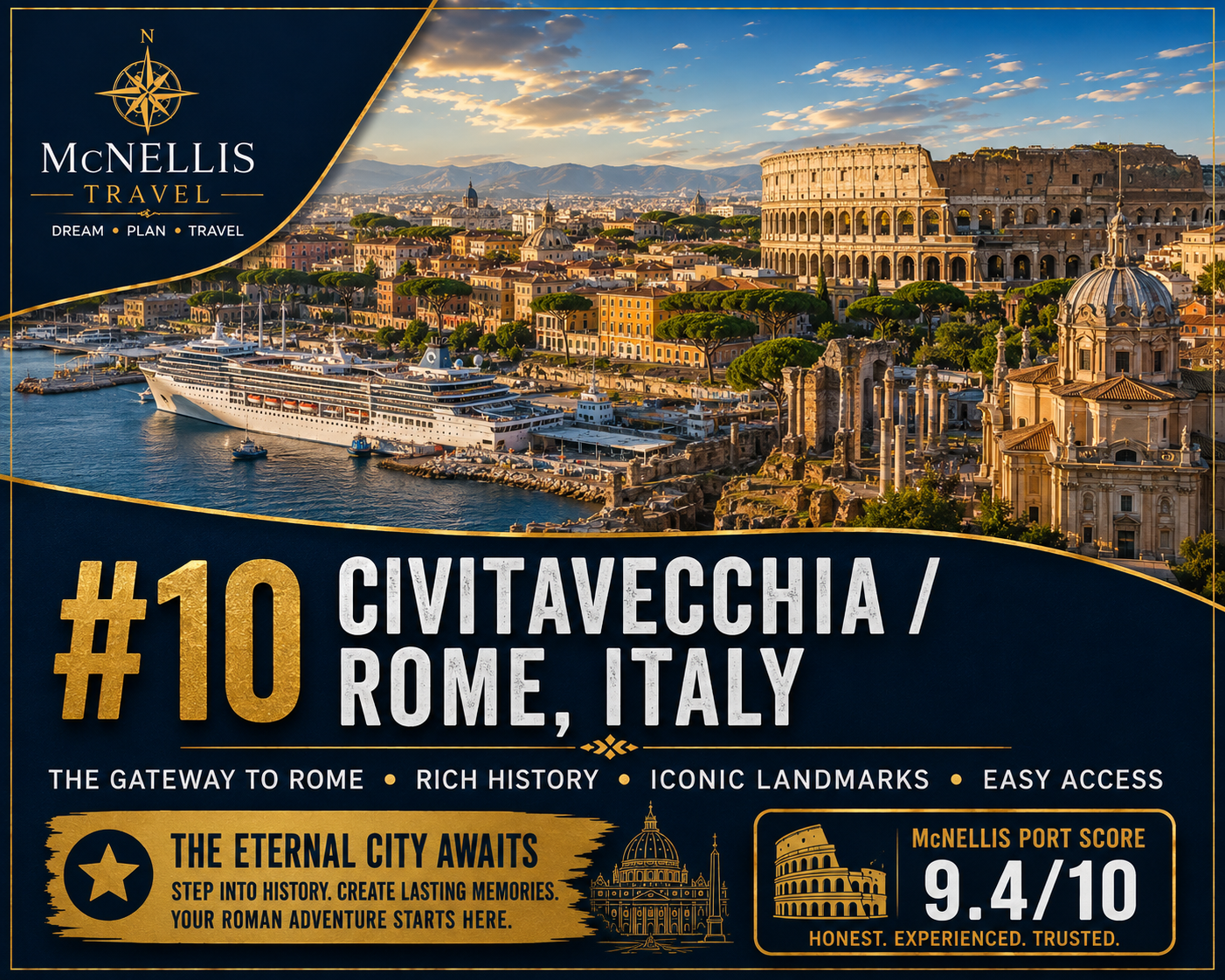
10 Civitavecchia / Rome, Italy
What Rome Is Really Like From a Cruise Ship
Rome is one of the greatest destinations on any Mediterranean itinerary. However, Civitavecchia is not Rome. Cruise ships dock roughly 50 miles from central Rome. This means a significant portion of your port call can disappear into transportation. Trains work well for confident independent travelers, while private transfers and organized excursions reduce logistical uncertainty. Choose your priorities wisely. A first visit built around the Colosseum and Roman Forum is already substantial. A Vatican-focused day can be equally fulfilling. Trying to combine every icon usually leads to more transit than experience.
Experience the Culture: Rome Is Layered, Not Frozen in Antiquity
Rome's cultural power comes from the fact that its history was never neatly packed away. Ancient columns stand beside apartment buildings. Renaissance palaces face busy streets. Baroque fountains occupy spaces Romans still cross on their way to work. Churches contain art that would anchor museums elsewhere. That continuity is worth noticing. Do not experience Rome only through a list of monuments. Trastevere can show another side of the city if your schedule allows time away from the biggest attractions. Markets, small piazzas, fountains, and neighborhood cafés reveal a capital that is lived in rather than simply preserved. Roman cooking has its own identity: cacio e pepe, carbonara, amatriciana, gricia, artichokes, and supplì belong more naturally to the city than generic Italian food sold near major attractions. Religious heritage also requires context. Vatican City is an independent state and the center of the Roman Catholic Church, while Rome contains hundreds of churches. Visitors entering active religious spaces should follow dress and behavior requirements, even if visiting primarily for art or architecture. Romans can seem direct in busy restaurants or transportation settings. Do not confuse speed with hostility. Begin with a greeting, be patient, and remember the city does not reorganize itself around cruise schedules. Most importantly, resist treating Rome as a scavenger hunt. Seeing three things well can create a stronger memory than photographing seven things while rushing toward the next reservation.
Know Before You Go
Italy is currently Level 2: Exercise Increased Caution under U.S. State Department guidance because of terrorism. Pickpocketing is also common on public transportation and in crowded areas. For cruise passengers, poor time management can be just as disruptive: leave a substantial margin for the return to Civitavecchia.
McNellis Port Verdict
Best for: Ancient history, art, religious heritage, and first-time European travelers. Potential drawback: The long port-to-city transfer. Would we choose an itinerary because Rome is included? Yes, but Rome is even better as an embarkation or disembarkation point with extra hotel nights. McNellis Port Score: 8.5/10
11 Livorno / Florence, Italy
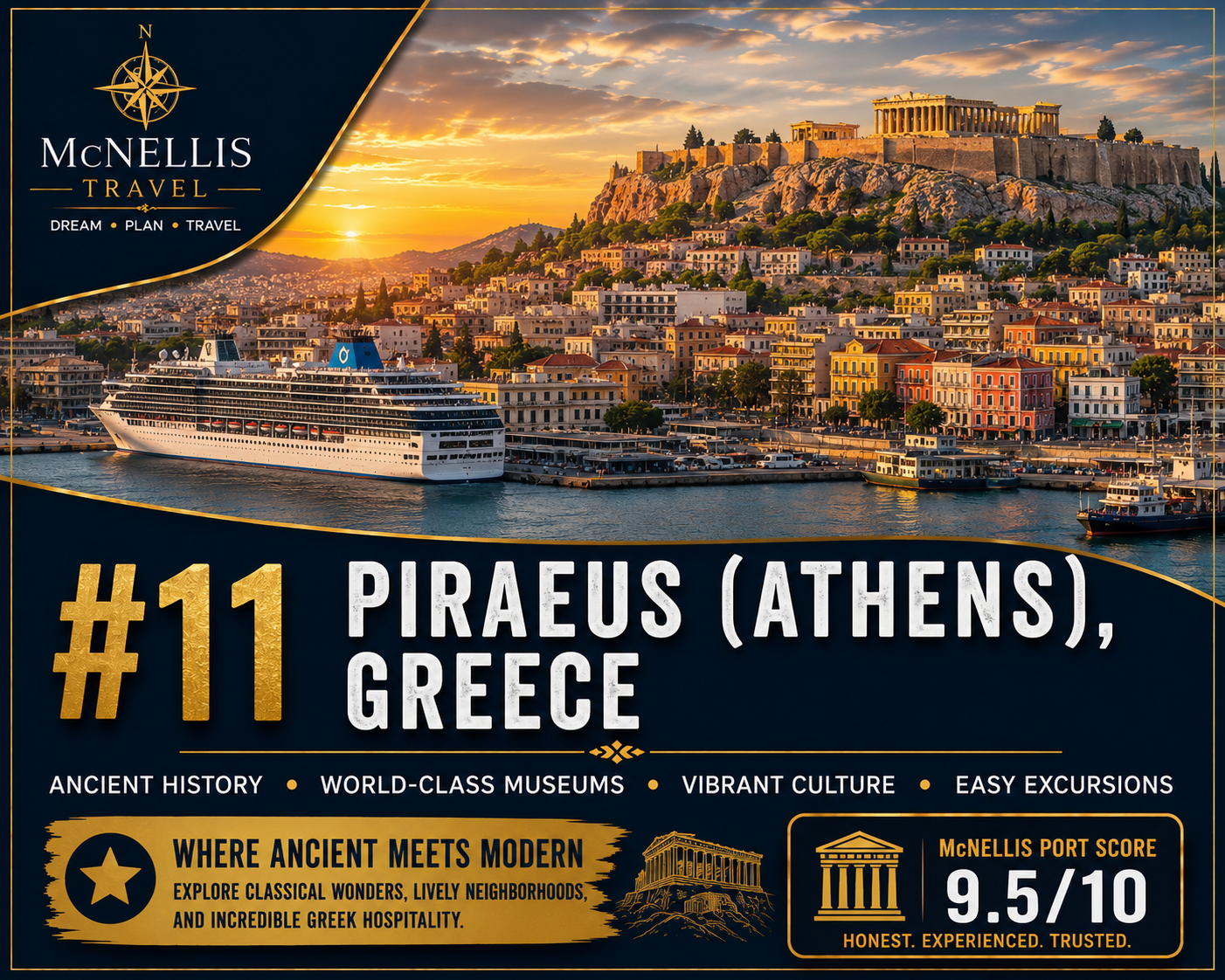
What Florence Is Really Like From a Cruise Ship
Livorno creates the same naming problem: the itinerary may say Florence, but the ship is on the Tuscan coast. Florence is roughly 55 miles inland, and Pisa, Lucca, and the countryside compete for the same limited day. Florence deserves focus. The Duomo, Uffizi, Accademia, Ponte Vecchio, and historic center can be combined selectively, but reservations and transportation time matter. If David or the Uffizi is essential, book timed entry rather than hoping the line cooperates.
Experience the Culture: Tuscany Is More Than a Renaissance Checklist
Florence's Renaissance legacy is so dominant that visitors can forget they are entering the capital of Tuscany, a region with a powerful identity of its own. Michelangelo, Botticelli, Brunelleschi, and generations of patrons changed Western art and architecture here. Cultural understanding improves when you connect those masterpieces to the city that produced them. The Medici were not simply names on museum labels; banking, politics, religion, trade, and family power shaped Florence for centuries. Craft traditions still matter. Leather goods, gold work, paper, and bookbinding remain associated with Florence, although tourist districts contain plenty of mass-produced merchandise. If craftsmanship interests you, look for workshops where the maker and process are visible. Tuscan food is often simpler than visitors expect. Ribollita, pappa al pomodoro, bistecca alla fiorentina, beans, crostini, and unsalted Tuscan bread reflect agricultural traditions. Wine culture extends far beyond ordering a Chianti; the surrounding region contains distinct wine zones, landscapes, and traditions. Florence rewards looking upward and sideways. Family crests, tabernacles, stonework, and courtyards can tell as much about the city's past as another crowded museum room. If you choose the countryside, remember farms, villages, and vineyards are working landscapes. A strong Florentine day has rhythm. One major museum, historic streets, a church or market, and a proper meal can be more satisfying than racing between every famous name on a map.
Know Before You Go
Italy's Level 2 advisory applies here too. The cruise-specific concerns are museum reservations, summer heat, and the distance back to Livorno. Independent rail travel can be practical, but missed connections matter when the ship will not wait.
McNellis Port Verdict
Best for: Renaissance art, architecture, Tuscan food, and wine. Potential drawback: Florence is reached from the port; it is not the port itself. Would we choose an itinerary because Florence is included? Yes, especially for a first visit to Tuscany. McNellis Port Score: 8.4/10
12 Kotor, Montenegro
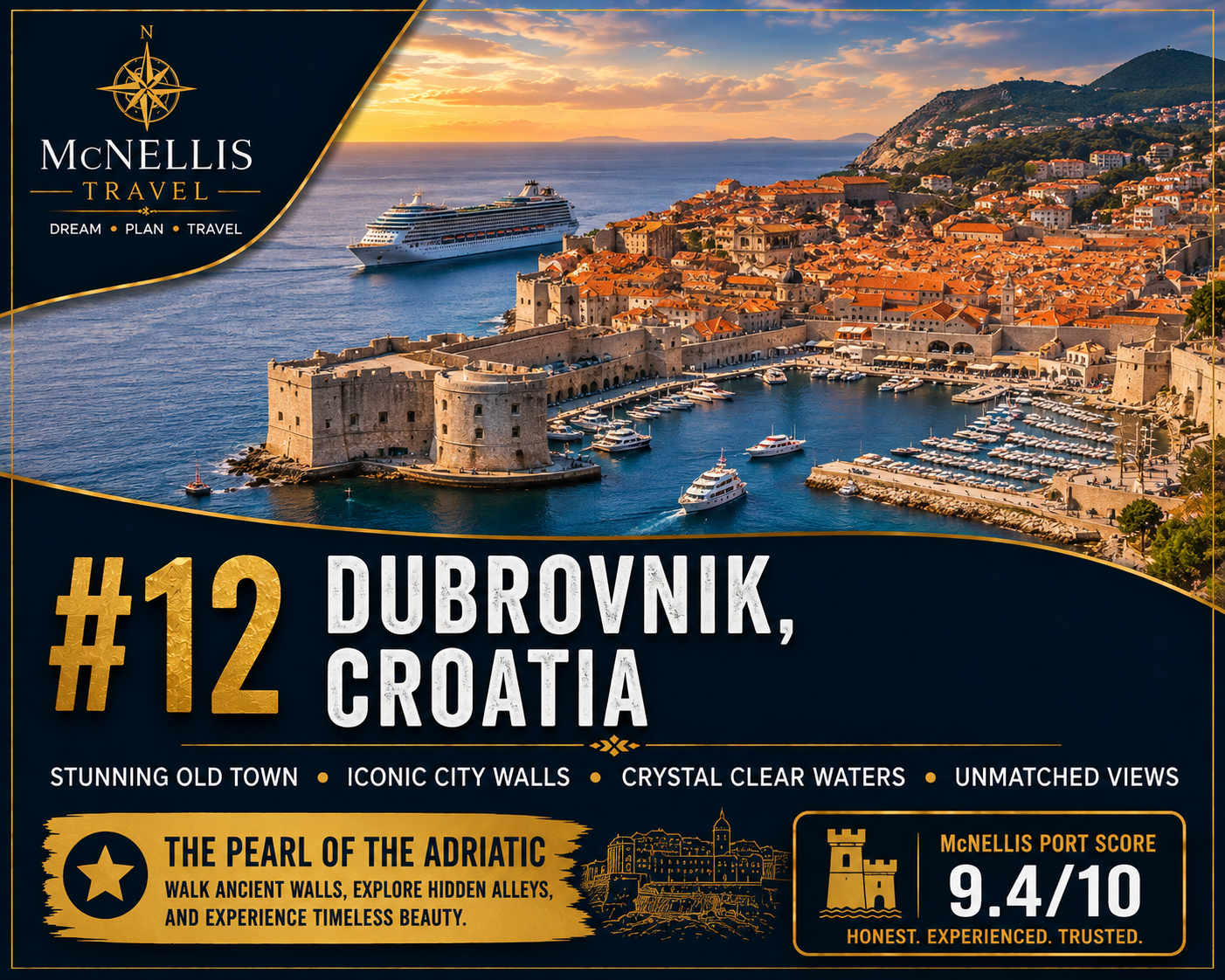
What Kotor Is Really Like From a Cruise Ship
Kotor's strongest attraction begins before you leave the ship. The approach through the Bay of Kotor is one of the region's most dramatic arrivals, with steep mountains dropping toward deep water and stone settlements along the shoreline. Ships may dock or tender. The walled Old Town is compact and immediately rewarding. The challenge is vertical: travelers wanting the famous views above Kotor face steep climbs and many steps. This is one port where doing less can work beautifully.
Experience the Culture: Look Beyond the View
Montenegro is small, but Kotor sits at a cultural crossroads shaped by the Adriatic, the Balkans, Venetian influence, and centuries of maritime trade. The Old Town's architecture reveals the long Venetian presence. Stone palaces, narrow lanes, churches, and fortified walls connect Kotor to the broader Adriatic world, but it is not simply a smaller Dubrovnik. Its identity belongs to Montenegro and to the Bay of Kotor, known locally as Boka. Maritime history is particularly important. Families from the bay built careers around seafaring, trade, and navigation, and the Maritime Museum provides context for why this small settlement accumulated so much architectural and cultural wealth. Religion reflects the region's complexity. Catholic and Orthodox churches stand within a relatively small area. Visitors need not master Balkan religious history in a morning, but recognizing these identities carry deep meaning is more respectful than treating every church as interchangeable medieval scenery. Food around the bay draws from both coast and mountains. Seafood, grilled fish, prosciutto from Njeguši, local cheeses, and Balkan meat dishes can all appear within a short distance. Montenegrin hospitality can feel relaxed and direct. Ask guides about modern Montenegro, independence, family life, and rapid coastal development. If you climb above town, stop occasionally rather than treating the fortress path as a race. The view explains Kotor's history: mountains provided protection, the bay provided connection, and the settlement developed between them.
Know Before You Go
The U.S. State Department updated Montenegro's advisory on August 27, 2026, and continues to list the country at Level 1: Exercise Normal Precautions. The main port-day issue is physical. Old Town paving can be uneven, and fortress routes involve steep stairs and exposed climbing in hot weather.
McNellis Port Verdict
Best for: Scenery, compact historic centers, and travelers who enjoy exploring on foot. Potential drawback: The most celebrated viewpoints require substantial climbing. Would we choose an itinerary because Kotor is included? Yes, particularly on an Adriatic itinerary. McNellis Port Score: 8.3/10
13 Palma de Mallorca, Spain
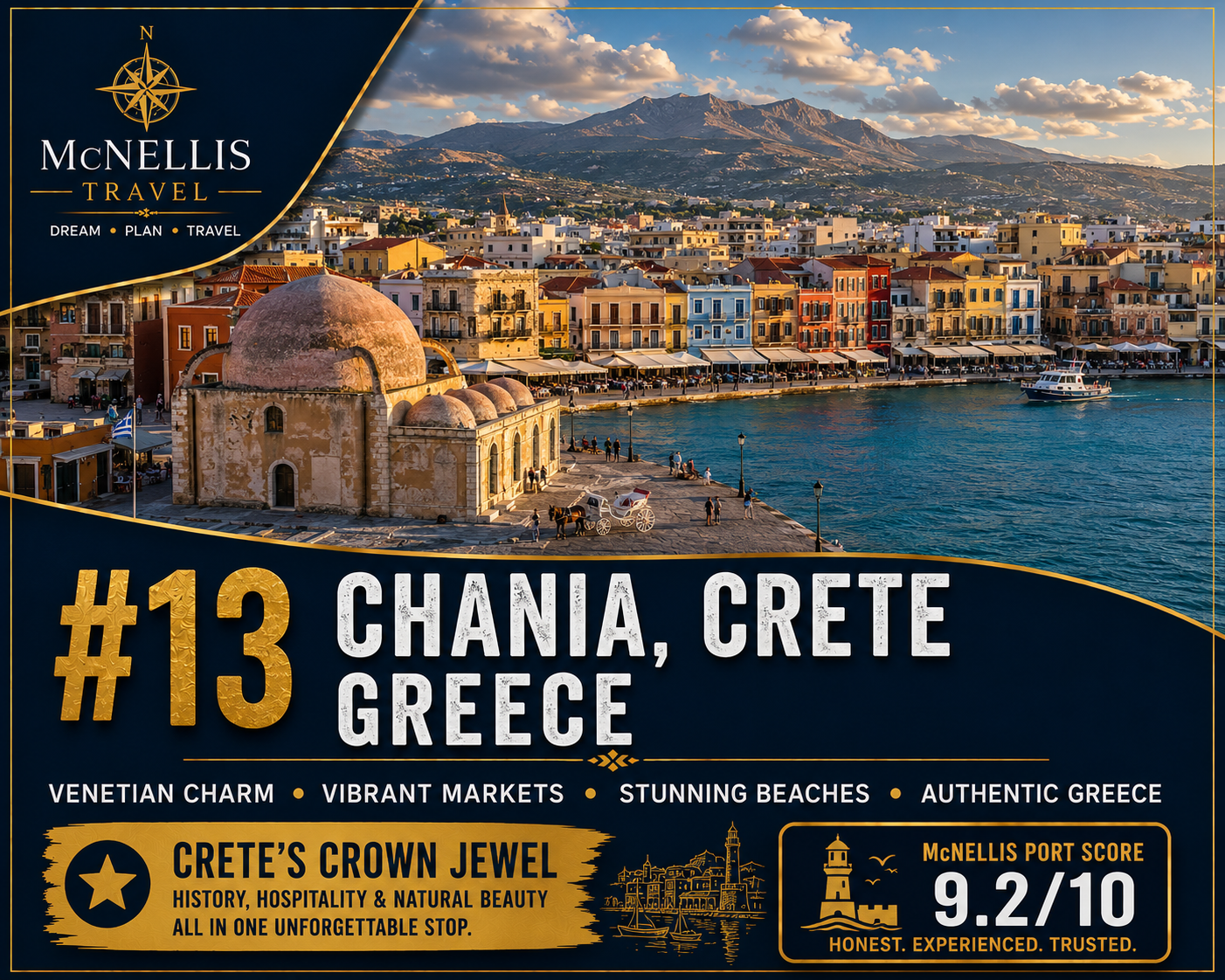
What Palma Is Really Like From a Cruise Ship
McNellis Port Score: 8.2/10
Best for: Travelers who want an easy old-city day with Balearic character, architecture, and the option to add a beach or countryside experience.
Biggest drawback: The island is far larger than the cruise-stop version of Palma, so trying to combine the historic center, distant beaches, and mountain villages in one call can turn a relaxed port into a rushed one.
Palma is one of the Mediterranean ports where the cruise day works best when you resist the urge to treat the entire island of Mallorca as one attraction. Ships use terminals around the Port of Palma, and the exact berth matters: some passengers face a substantial walk or need a shuttle or taxi before they are truly in the historic center. Once there, the monumental landmark is La Seu, Palma's Gothic cathedral, but the more revealing experience is the network of lanes, courtyards, markets, and neighborhoods around it. This is a living island capital rather than a purpose-built resort stop, and its rhythm changes quickly once you move away from the waterfront and headline sights.
Mallorcan identity is not simply a smaller version of mainland Spanish culture. The Balearic Islands have their own history, food traditions, and Catalan-language heritage; Mallorquí is the local variety of Catalan, while Spanish is also widely used. Travelers do not need to perform local identity to be respectful, but recognizing it changes the way the island makes sense. Look for ensaïmada, sobrasada, tumbet, and island-grown products rather than assuming paella and sangria define the local table. Markets can be useful cultural stops when approached as places where residents shop and eat, not merely as photo backdrops.
Palma also sits inside a much larger tourism debate. Mallorca receives enormous visitor numbers, and residents have publicly raised concerns about housing pressure, congestion, and the effects of mass tourism. That does not mean visitors are unwelcome. It does mean cruise passengers can improve the experience by spending with local businesses, keeping noise down in residential lanes, respecting beach and public-space rules, and not treating private doorways or homes as scenery. If you want a deeper island day, choose one clear extension—such as Valldemossa, Sóller, or a focused coastal experience—rather than racing between several distant points.
For U.S. travelers, Spain is currently under a Level 2 State Department advisory, meaning exercise increased caution. In practical port-day terms, situational awareness around crowds, transportation hubs, and major attractions matters more than fear. Palma is generally straightforward for independent exploration, but travelers with mobility limitations should confirm terminal transfers and walking distances in advance. The old center includes uneven surfaces, and summer heat can make a modest route feel much longer than it looks on a map.
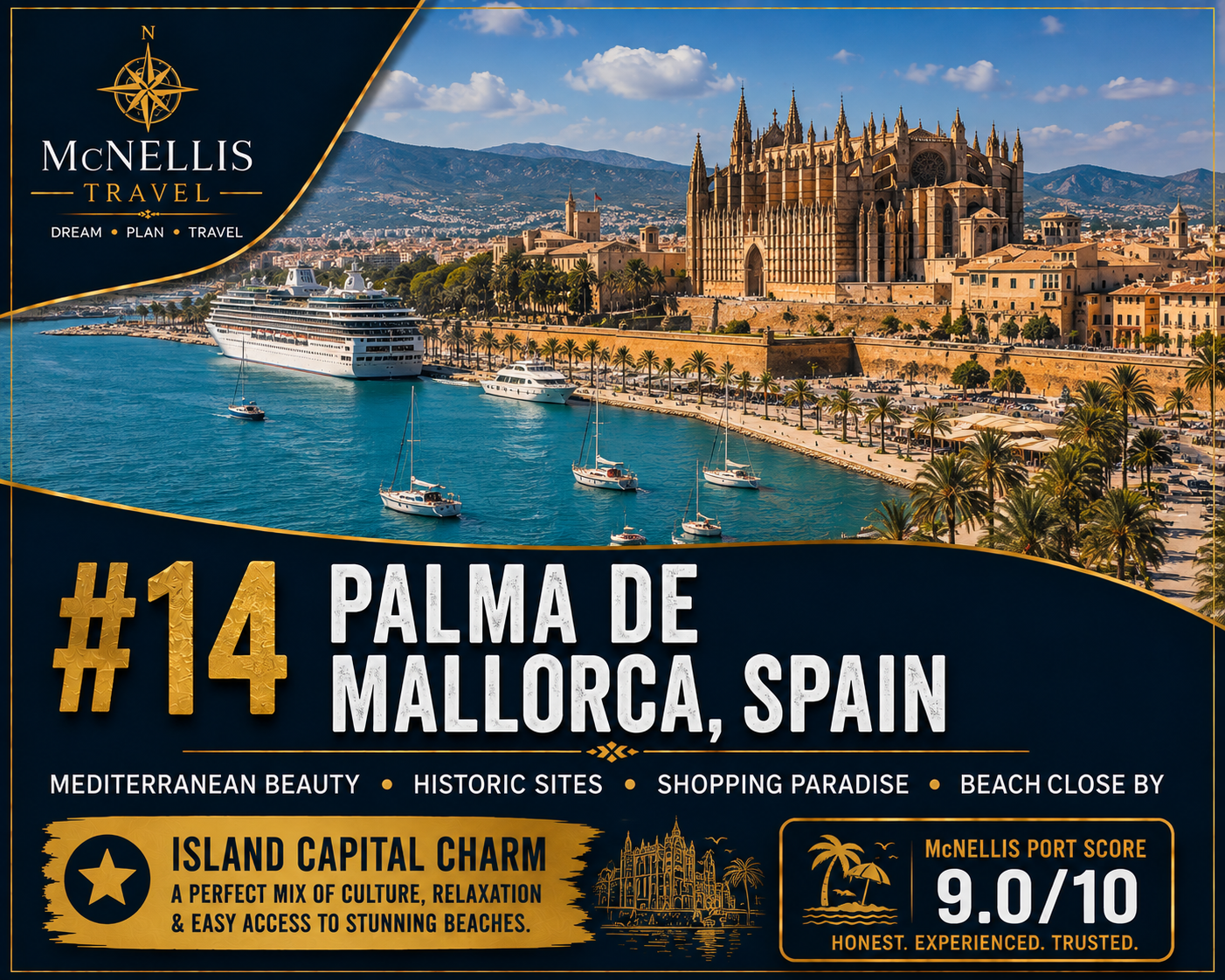
14 Mykonos, Greece
What Mykonos Is Really Like From a Cruise Ship
McNellis Port Score: 8/10
Best for: Travelers who want iconic Cycladic scenery, a compact old town, and a social, stylish Greek-island atmosphere.
Biggest drawback: Crowds, wind, tender or shuttle logistics, and high prices can overwhelm the charm on heavy ship days.
Mykonos is famous enough that many passengers arrive with a fully formed image of whitewashed walls, blue details, windmills, and narrow lanes before they ever step ashore. The real port experience depends heavily on how your ship handles arrival. Some ships berth at Tourlos, north of Mykonos Town, while others may tender. That distinction affects how quickly you reach Chora and how much buffer you need for the return. Once in town, the maze-like lanes are part of the experience, but they also concentrate thousands of visitors into a small footprint when several ships overlap.
The most useful cultural lens here is to remember that Mykonos is both a Cycladic island community and an international tourism phenomenon. Its global reputation for nightlife, luxury, and LGBTQ+ hospitality is real, but it is not the entirety of the island. Churches, family businesses, fishing traditions, and everyday Greek Orthodox life coexist with beach clubs and designer storefronts. Dress expectations are relaxed in resort areas, yet entering a church still calls for ordinary respect: quiet behavior and appropriate clothing matter even when the street outside feels like a party destination.
Mykonos has long been one of Greece's better-known LGBTQ+-friendly destinations, particularly in the tourism centers. That reputation can make it a comfortable stop for many LGBTQ+ cruise travelers, but normal travel awareness still applies. Greece's current U.S. advisory is Level 1, exercise normal precautions. Travelers should still watch belongings in dense tourist areas, understand their ship's tender or shuttle process, and leave enough time to return without turning the final hour into a sprint.
To experience more than the postcard, decide what you actually want from the call. A first visit can justify staying in Chora, walking Little Venice and the windmills, then lingering over a meal instead of stacking excursions. Travelers more interested in archaeology can consider Delos when schedules and conditions allow; beach-focused visitors should choose one beach rather than attempt an island-wide sampler. Mykonos is better when you let one version of the island breathe.
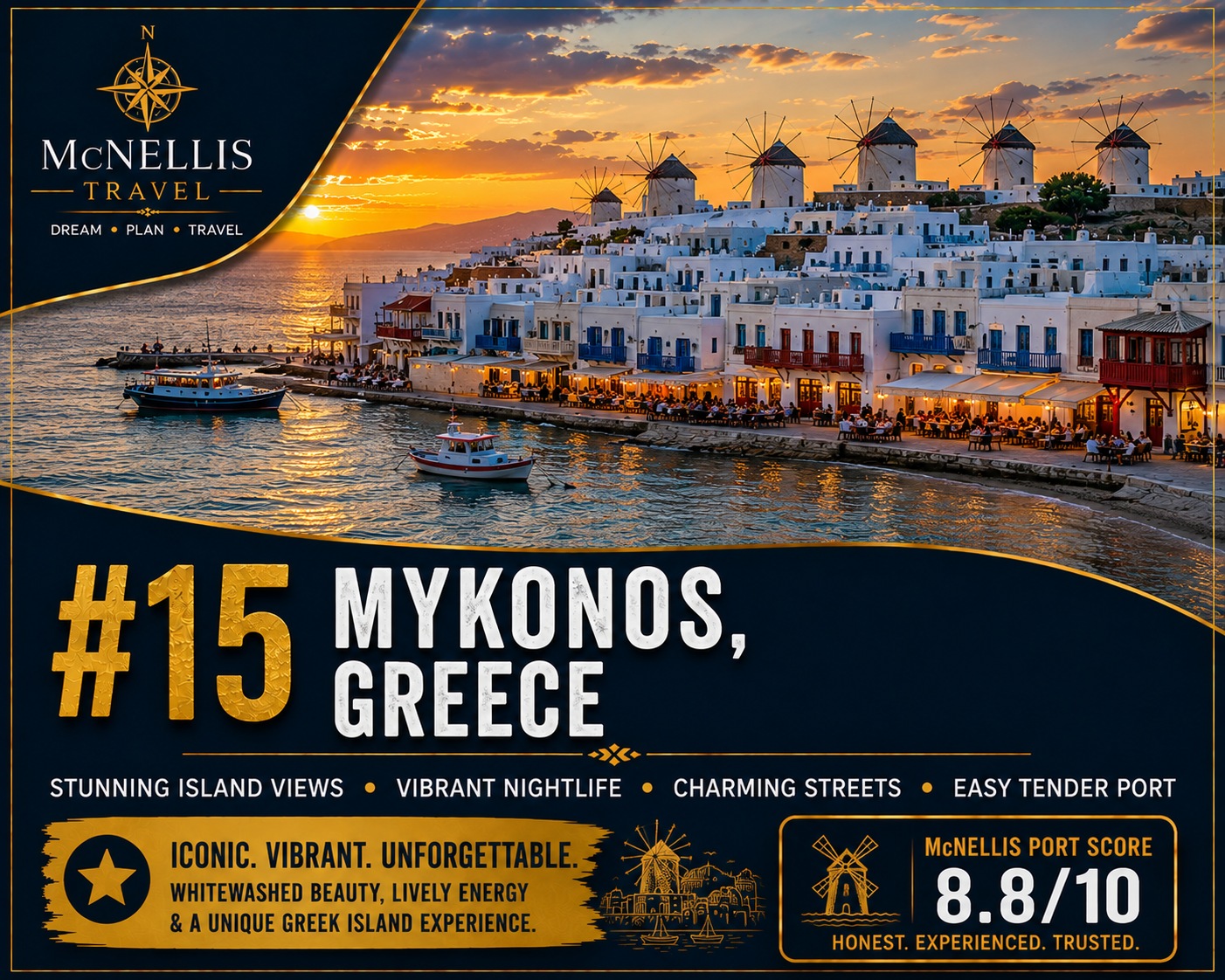
15 Split, Croatia
What Split Is Really Like From a Cruise Ship
McNellis Port Score: 7.9/10
Best for: History lovers who enjoy a city where Roman architecture is woven directly into modern daily life.
Biggest drawback: Summer congestion can make the compact historic core feel more like a corridor than a city if you visit only the busiest streets.
Split offers something different from a preserved archaeological site: Diocletian's Palace is not separated from the modern city. Shops, homes, cafés, churches, and passageways occupy the Roman imperial complex and the medieval layers built into it. That makes the center unusually rewarding for travelers who slow down enough to notice how columns, basements, courtyards, and later buildings have been reused rather than simply preserved behind barriers.
Cruise access is one of Split's strengths. Depending on berth and operations, passengers can often reach the historic center with relatively little transfer time compared with ports where the headline destination is an hour or more inland. That makes independent exploration realistic. The Riva waterfront is the obvious orientation point, but the cultural payoff increases when you move through the palace gates, markets, and side streets and understand Split as a working Dalmatian city rather than a single UNESCO attraction.
Dalmatian culture reflects centuries of Adriatic exchange. Roman, Venetian, Slavic, Austro-Hungarian, and Yugoslav histories all leave traces, while contemporary Croatian identity is its own story. Food is an accessible entry point, but the goal is not another generic Mediterranean tasting list. Look for regional seafood, pašticada, local olive oil, and dishes shaped by the coast and hinterland. Coffee culture is also social time; occupying a table for a conversation rather than treating every stop as a ten-minute refueling break is closer to the local rhythm.
Croatia is currently Level 1 on the U.S. State Department scale. Split's more common cruise-day challenges are heat, slick or uneven historic paving, and crowd concentration. Respect inside churches and religious spaces remains important, and travelers should remember that residential life continues inside and around the palace. If the old core is packed, the solution is not necessarily another bus excursion. A quieter neighborhood walk, Marjan viewpoints when appropriate for your mobility, or simply allowing extra time outside the main procession can reveal more of the city.
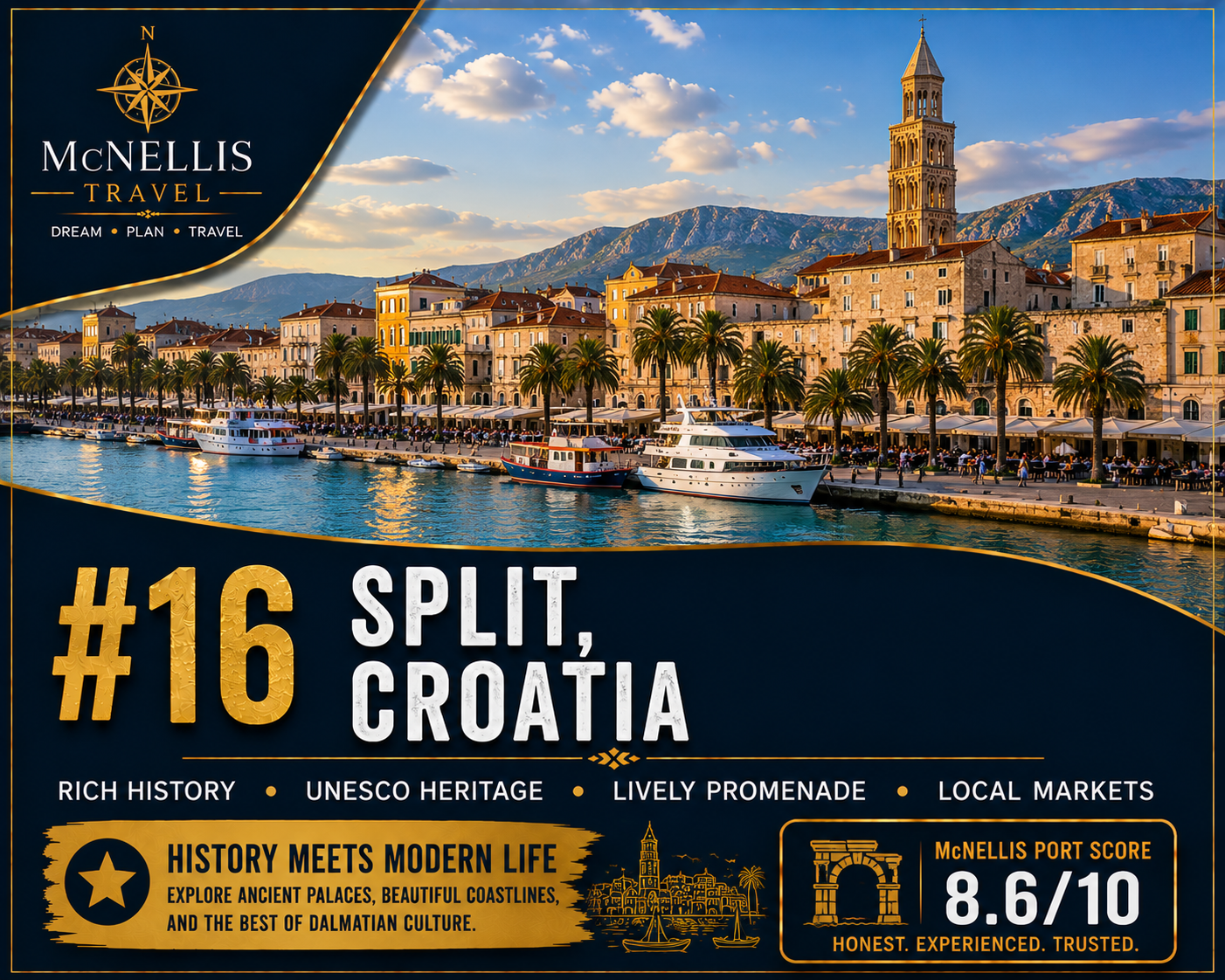
16 Corfu, Greece
What Corfu Is Really Like From a Cruise Ship
McNellis Port Score: 7.7/10
Best for: Travelers who want a Greek island with a strong Venetian visual identity, walkable old town, and easy access to broader island scenery.
Biggest drawback: The island's famous viewpoints and beaches are spread out, so transportation choices determine how much of the day is spent moving rather than experiencing.
Corfu immediately feels different from the Cycladic Greece many first-time visitors expect. Corfu Town carries a strong Venetian inheritance, with arcaded streets, fortifications, pastel façades, and an urban form shaped by centuries at the entrance to the Adriatic. British and French periods also left marks. That layered history is the reason the port deserves more than a quick comparison with Santorini or Mykonos: the architecture, music, food, and civic traditions belong to the Ionian world.
Cruise ships use the port near Corfu Town, but passengers should still account for the transfer from the terminal area into the old center. Once there, much can be explored on foot. The Old Fortress, Spianada, and Liston establish the city's grander face, while churches, lanes, and neighborhood life provide the texture. The island is associated with Saint Spyridon, Corfu's patron saint, and religious processions and traditions remain meaningful local events rather than entertainment staged for visitors.
Corfiot food also reflects the island's history. Dishes such as sofrito and pastitsada show Italian and Venetian influence while remaining distinctly local. Kumquat products became another recognizable island specialty. The useful lesson for a cruise passenger is that Corfu's culture makes more sense when you stop trying to fit every Greek island into the same template. A meal built around local dishes, a conversation about the island's history, or time listening to Corfu's noted musical traditions can be as culturally valuable as another panoramic photo stop.
Greece remains Level 1 under the current U.S. advisory. For most passengers, planning decisions are more immediate: summer heat, uneven paving, and the distance between Corfu Town and island attractions such as Paleokastritsa. If you leave town, use a realistic itinerary and preserve return-time margin. If mobility is limited, a well-planned old-town visit can still be rewarding without trying to cover the island.
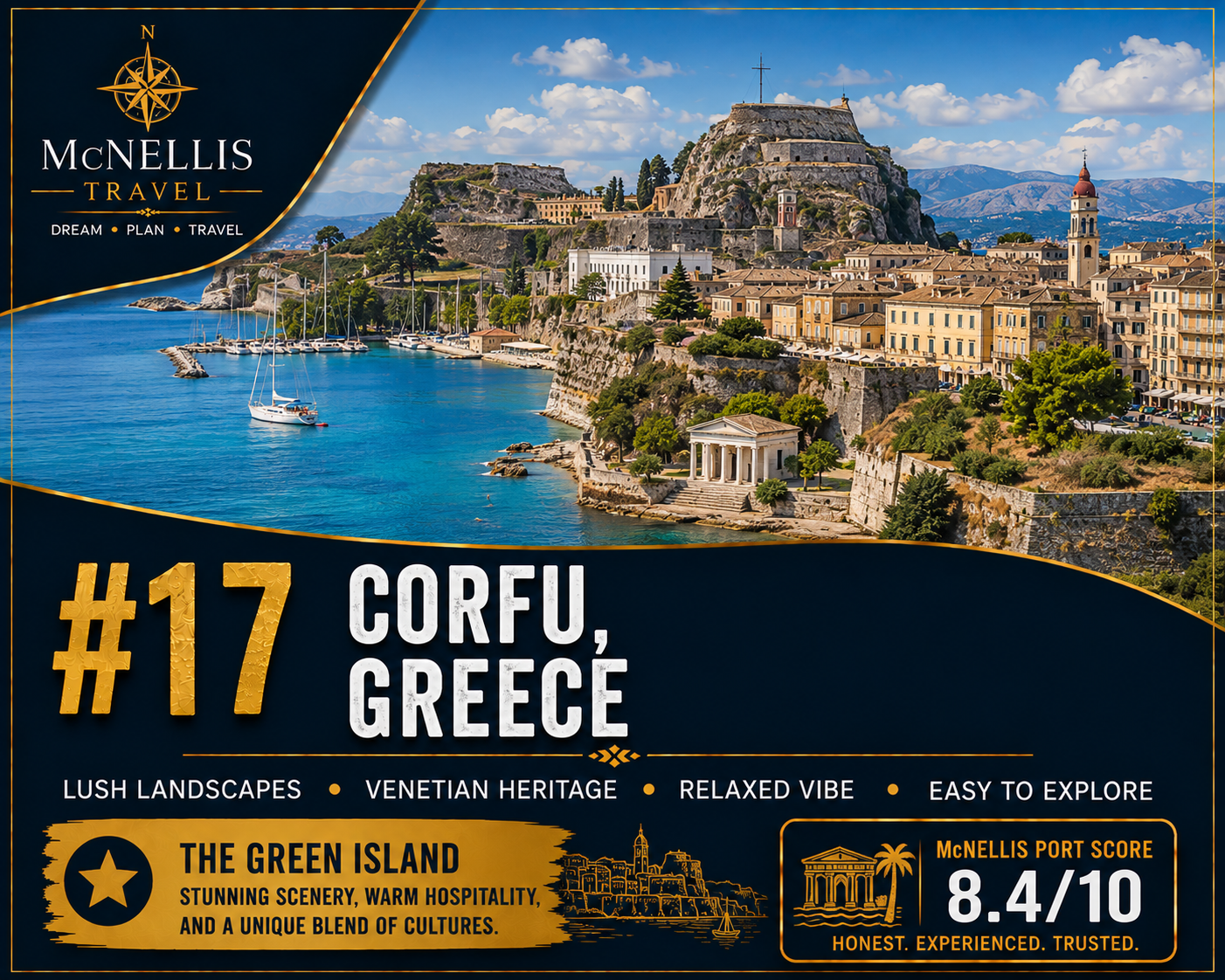
17 Sicily: Messina & Taormina, Italy
What Sicily Is Really Like From a Cruise Ship
McNellis Port Score: 7.5/10
Best for: Travelers drawn to dramatic Sicilian landscapes, Greek and Roman history, and a destination with a powerful regional identity.
Biggest drawback: Taormina is not the port itself, and transfer time plus steep terrain can consume a significant share of a short call.
Messina is the gateway, but many cruise itineraries sell the day through Taormina, Mount Etna, or a combination of eastern Sicily highlights. That distinction needs to be understood before booking anything. A ship calling at Messina does not place you in Taormina. The journey is part of the day's time budget, and Taormina itself sits high above the coast. The payoff can be exceptional—the ancient theatre and views toward Etna are among Sicily's defining images—but the logistics should be judged honestly against the length of the port call.
Sicily is not culturally interchangeable with mainland Italy. The island's history includes Greek colonies, Roman rule, Arab and Norman kingdoms, Spanish influence, and later incorporation into modern Italy. Architecture, language, food, and local identity carry those layers. Eastern Sicily gives travelers an unusually clear way to see that history physically: Greek theatres, Norman churches, Baroque rebuilding, and the ever-present volcanic landscape are not separate chapters so much as overlapping ones.
Food can illuminate those layers when you choose specifically Sicilian dishes rather than simply ordering familiar Italian standards. Arancini or arancine terminology itself can trigger regional debate; granita with brioche, cannoli, citrus, pistachio, seafood, and sweets with Arab-influenced ingredients all tell parts of the island's story. Treat that regional pride seriously. Sicily has often been reduced in foreign popular culture to stereotypes about organized crime. That is not a respectful or useful way to engage residents or understand a complex island of more than five million people.
Italy remains Level 2 on the U.S. State Department advisory scale. In eastern Sicily, ordinary cruise-day awareness includes belongings in busy areas, heat, and transportation timing. Taormina has inclines, stairs, and uneven surfaces; travelers with mobility concerns should verify exactly where transportation drops them and how much walking the excursion requires. Etna excursions introduce a different physical environment again, including altitude, variable weather, and volcanic terrain. Choose the version of Sicily that fits your abilities instead of trying to prove how much can fit into one day.
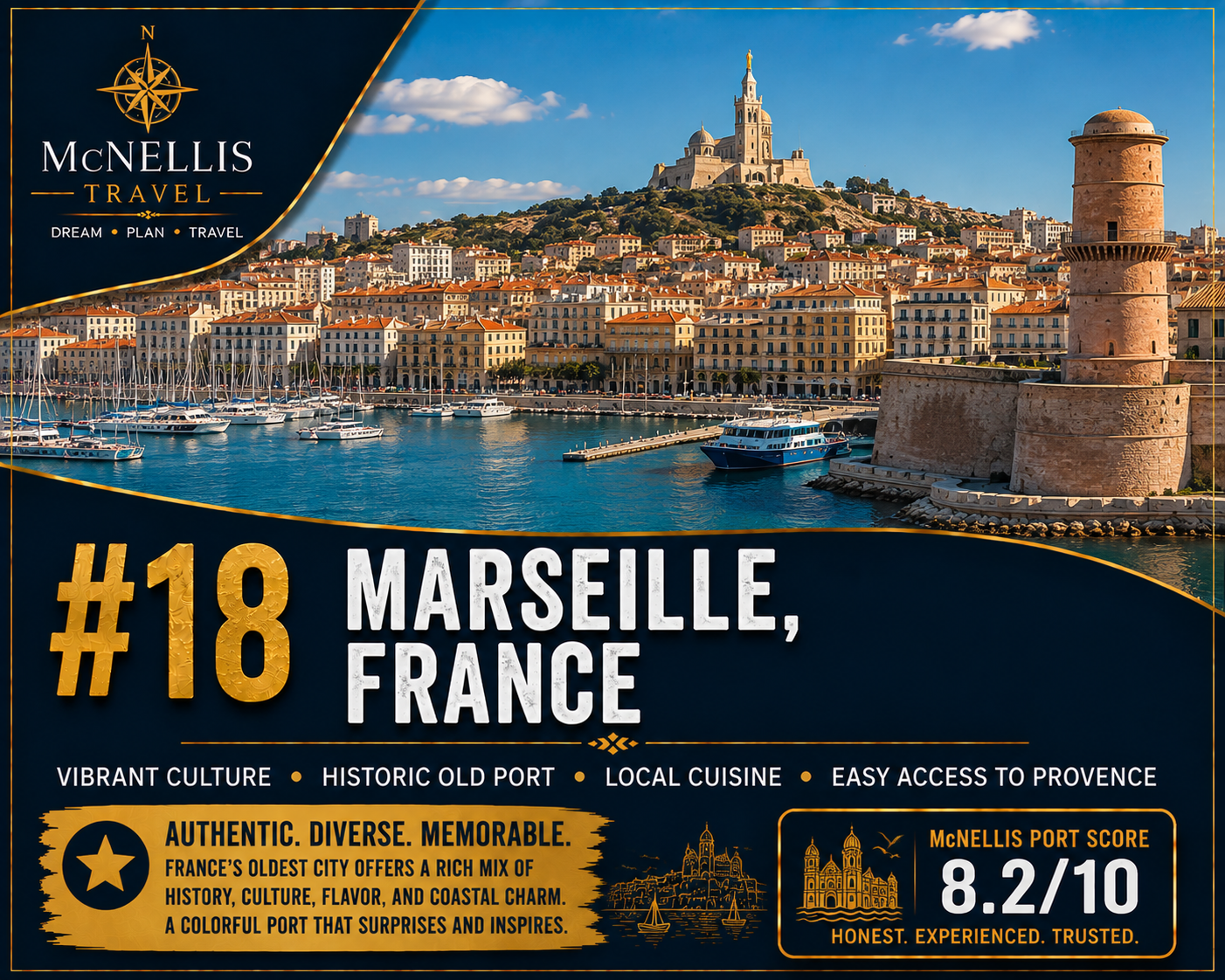
18 Marseille, France
What Marseille Is Really Like From a Cruise Ship
McNellis Port Score: 7.3/10
Best for: Travelers interested in a working Mediterranean city, Provençal culture, immigration history, and food rather than a polished resort-port experience.
Biggest drawback: The cruise terminals can be far from the center, and travelers expecting a compact Riviera-style stop may misread the city.
Marseille finishes our ranking not because it lacks importance, but because it asks more of a cruise passenger. France's oldest major city is a working port with a scale and social complexity very different from the manicured image many travelers associate with the Côte d'Azur. Large cruise ships commonly use terminals that require transportation into the central city, so the first planning question is not what to photograph but how you will get between the ship and the neighborhoods you actually want to experience.
The Vieux-Port is the natural starting point, but Marseille's identity extends well beyond it. The city has been shaped for more than two millennia by movement across the Mediterranean. Greek origins, Provençal traditions, North African migration, Corsican and Italian connections, and later global communities have all contributed to modern Marseille. That mixture is central to the city's character. Travelers who arrive expecting a homogeneous version of France can miss what makes Marseille historically and culturally significant.
Bouillabaisse is the famous culinary reference, but ordering it responsibly means understanding that traditional versions can be expensive and are not a casual bowl of generic seafood soup. Markets, bakeries, North African food, Provençal products, and neighborhood cafés may tell a broader story of the city. Marseille rewards curiosity, but cultural curiosity should not become poverty tourism: diverse residential neighborhoods are communities, not attractions to be consumed because they look 'gritty' or different from home.
France is currently Level 2 under the U.S. State Department advisory. In Marseille, travelers should use normal big-city awareness, especially around crowded transit areas and tourist zones, and should keep valuables controlled. Those practical cautions should not be exaggerated into a claim that visitors need to avoid the city. The better question is whether Marseille matches your travel style. If you want an easy, self-contained postcard port, other stops rank higher. If you value urban history, migration stories, Provençal culture, and a city that does not exist solely for visitors, Marseille can be one of the more thought-provoking calls in the Mediterranean.
What the Bottom Half of the Ranking Actually Tells You
Ranking #10 through #18 does not mean these are bad Mediterranean ports. Several are extraordinary destinations. The lower positions mostly reflect cruise-day friction: long transfers, crowded historic centers, difficult terrain, tendering, terminal distance, or the simple fact that the most famous attraction is not where the ship docks. That distinction matters when you compare itineraries. A port can be world-class and still demand more planning than another stop.
The strongest itinerary is therefore not necessarily the sailing with the greatest number of famous names. Look at how those names function as cruise ports. Rome and Florence can create unforgettable days, but both require substantial travel from Civitavecchia or Livorno. Mykonos can be wonderfully simple if your goal is Chora, but weather and ship operations can change the arrival experience. Marseille can disappoint someone expecting a compact Riviera postcard while rewarding a traveler interested in a complex working Mediterranean city.
Part 2 Category Winners
Best for monumental history: Rome from Civitavecchia — if you accept the transfer and plan the day tightly.
Best for art and Renaissance culture: Florence from Livorno — a high-reward day that needs realistic transportation planning.
Best dramatic arrival and compact old town: Kotor — scenery and history combine unusually well when crowd levels cooperate.
Best balanced island-city day: Palma de Mallorca — strong architecture, local culture, and several ways to shape the day without forcing a full-island tour.
Best iconic Greek-island atmosphere: Mykonos — especially for travelers who want Chora, waterfront scenery, and a social island experience.
Best living-history city: Split — Roman architecture is part of the modern city rather than isolated from it.
Best for a different side of Greece: Corfu — Ionian, Venetian, and Greek influences create an identity distinct from the Cyclades.
Best landscape-and-history combination: Sicily via Messina — particularly when Taormina or Etna is the clear focus rather than one stop among many.
Best for travelers who prefer a real working city to a polished resort stop: Marseille.
How to Use All 18 Rankings to Choose a Mediterranean Cruise
Do not choose your sailing by adding up port scores. Use the rankings to identify what kind of vacation the itinerary creates. A route heavy on Rome, Florence, Athens, and Ephesus can be culturally exceptional but physically demanding. A route built around islands may reduce long inland transfers but introduce tenders, steep terrain, and seasonal crowd pressure. Adriatic itineraries can place you closer to historic centers, yet several compact old towns become intensely crowded when ships overlap.
If you are still comparing regions rather than individual ports, use our Mediterranean destination planning page to compare the broader vacation possibilities. For travelers ready to compare ships and cruise lines, the McNellis cruise planning hub is the commercial starting point for current cruise options. Each of those links serves a different purpose, so there is no reason to repeat them throughout the article.
Itinerary length matters too. A seven-night cruise can be excellent, but stacking difficult port days back-to-back changes the experience. Our guide to how many days you really need for a Mediterranean cruise explains why a longer sailing can sometimes feel substantially better even when it does not add many more headline destinations.
A Port Ranking Cannot Replace the Itinerary
A port ranking is useful only when it helps you make a better decision. Your mobility, tolerance for heat, interest in museums or beaches, comfort with independent transportation, budget for excursions, and willingness to spend two hours reaching a city can completely change which port belongs at the top of your personal list.
That is also why we included culture, local expectations, and traveler considerations rather than ranking destinations only by scenery. You are entering places where people live, worship, work, and raise families. A better cruise passenger understands that the privilege of visiting a destination comes with a basic responsibility to learn how the place works and to behave accordingly.
Frequently Asked Questions About Mediterranean Cruise Ports
Is Rome actually a cruise port?
No. Most cruise itineraries marketed as Rome call at Civitavecchia, roughly northwest of the city. The transfer is a major part of the day and should be included when deciding how much sightseeing is realistic.
Is Florence actually at the port of Livorno?
No. Livorno is the cruise gateway for many Florence and Tuscany excursions. Florence is inland, so transportation time and return-to-ship margin are essential parts of the plan.
Which Part 2 ports are easiest to explore independently?
Split is particularly convenient because the historic core is close to the port area. Kotor can also be straightforward when ships dock or tender efficiently, while Palma, Corfu Town, and central Mykonos can work independently once you account for the terminal, shuttle, or tender arrangements.
Which ports require the most careful excursion planning?
Rome/Civitavecchia and Florence/Livorno demand the most obvious transfer planning. Sicily can also require careful timing when Taormina or Mount Etna is the goal. The issue is not whether these places are worth visiting; it is how much usable time remains after transportation.
Are Mediterranean cruise ports suitable for travelers with limited mobility?
Some are, but the experience varies dramatically. Cobblestones, steep streets, stairs, heat, tender boats, and distant transportation drop-offs can create barriers. Travelers should evaluate the exact berth, excursion walking requirements, and accessible transportation before booking rather than relying only on the destination name.
Should U.S. travelers check travel advisories before a Mediterranean cruise?
Yes. Government advisories and entry information can change. Check the U.S. Department of State guidance for every country on the itinerary close to departure, and also review the cruise line's communications because port calls can change for weather, security, operational, or local reasons.
Is a higher-ranked port always better for my cruise?
No. The scores reflect our assessment of the overall cruise-port experience, not a universal rule. Someone passionate about Roman history may value Civitavecchia/Rome above a more convenient island stop, while a traveler who dislikes long bus rides may make the opposite choice.
Ready to Compare Mediterranean Cruises?
Once you know which ports matter most, the next step is comparing actual itineraries—not simply looking for the lowest advertised fare. Ship, cabin, port times, overnight flights, pre-cruise hotels, excursion strategy, and the sequence of demanding days all affect whether the vacation feels exciting or exhausting.
McNellis Travel can compare those pieces around your dates, budget, and travel style. When you are ready, request a free travel quote and tell Margen which Mediterranean ports are priorities, which ones you would happily skip, and how active you want the trip to feel. That gives us a much better starting point than simply asking for 'a Mediterranean cruise.'
Missed the first half of the ranking? Read Mediterranean Cruise Ports Ranked: What Each Stop Is Really Like — Part 1 for #1 through #9, including Barcelona, Istanbul, Valletta, Santorini, Athens/Piraeus, the French Riviera, Naples, Kuşadası & Ephesus, and Dubrovnik.